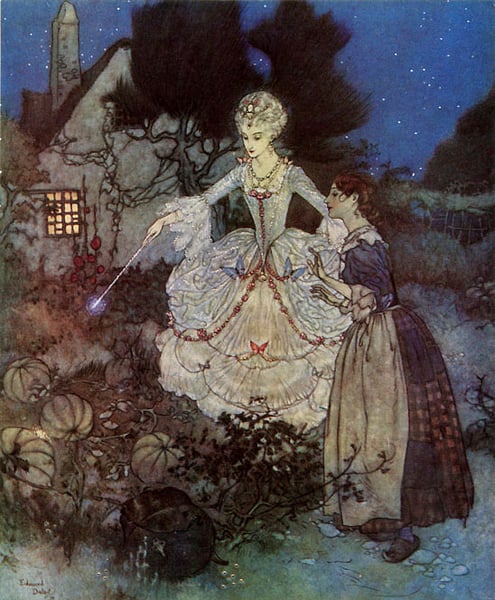
Cinderella - from the Picture Book for the Red Cross
Dettagli
Analisi esperta di Cinderella - from the Picture Book for the Red Cross di Edmund Dulac
Stile: Art Nouveau (Modern) · Genere: illustration
Expert Analysis: "Cinderella - from the Picture Book for the Red Cross" by Edmund Dulac
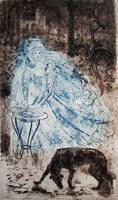
Edmund Dulac’s "Cinderella" from the Picture Book for the Red Cross stands as a luminous exemplar of Art Nouveau illustration at the height of its golden age. Created during World War I (1915–1916) as part of a charity publication for the British Red Cross, the work transcends mere storybook decoration to become a sophisticated synthesis of decorative elegance, symbolic storytelling, and wartime humanitarian purpose.
Key Artistic Significance
1. Mastery of Art Nouveau Aesthetics
Dulac’s illustration embodies the quintessential hallmarks of the Art Nouveau movement: sinuous, undulating lines (the whiplash curve), ornamental flatness, and a harmonious blend of natural forms with stylized abstraction. The composition likely features Dulac’s hallmark fluid silhouettes — Cinderella’s gown and the fairy-tale setting are rendered with flowing, organic contours that echo the movement’s obsession with curvilinear grace. The use of rich, jewel-toned watercolors (often layered with opaque gouache and gold highlights) creates a luminous, stained-glass effect, typical of Dulac’s technique.
2. Reimagining Fairy Tale as Modern Icon
Unlike earlier Victorian illustrators (e.g., Walter Crane or Arthur Rackham), Dulac’s Cinderella is not a passive maiden but a poised, almost ethereal figure — a modern Art Nouveau muse. Her elongated posture, delicate features, and ornate costume reflect the period’s fascination with the femme fatale and the exotic Orient (influenced by Japanese ukiyo-e prints and Persian miniatures). The pumpkin coach and fairy godmother, if depicted, would be transformed into abstract, decorative motifs — a shimmering swirl of golden lines and floral patterns — blending the magical with the ornamental.
3. Contextual Significance: Art for a Cause
The Picture Book for the Red Cross was a collaborative wartime publication by leading illustrators (including Dulac, Arthur Rackham, and Walter Crane), sold to raise funds for medical aid. Dulac’s contribution is significant not only for its aesthetic beauty but for its role in demonstrating how high-style illustration could serve a humanitarian purpose. The Cinderella narrative — a story of transformation and hope — resonated deeply with a public enduring the hardships of war, making the image both a commercial success and a morale-boosting cultural artifact.
4. Dulac’s Legacy as a Colorist and Synthesizer
Dulac was a master of color harmony, often using complementary palettes (e.g., midnight blues with fiery oranges and gilded edges) to create dramatic contrast and emotional depth. In Cinderella, the interplay of cool moonlight tones against warm, magical light would have been a technical tour de force, heightening the dreamlike atmosphere. His cross-pollination of Persian miniature detail, Japanese print simplicity, and Pre-Raphaelite romanticism makes this work a pivotal bridge between the 19th-century illustrator tradition and the emerging modernist sensibility.
Conclusion
"Cinderella" is far more than a mere picture-book plate: it is a concentrated testament to Edmund Dulac’s genius for transforming a well-known fairy tale into a visual poem of Art Nouveau elegance. Its significance lies in its perfect marriage of decorative style and narrative emotion, its role in a landmark wartime charity project, and its enduring influence on the perception of illustration as a fine art form. In Dulac’s hands, Cinderella’s ragged dress to shimmering gown becomes a metaphor for the very process of artistic alchemy — the mundane transformed into the sublime through line, color, and light.
Genere
Stile
Visivamente simili
20 opere con composizione e palette affini
Design of Costume for Awnings T. Karsavina (To Dance to Music by Mozart)
Konstantin Somov
Lady in Blue
Victor Borisov-Musatov
Stages of Cruelty
Ford Madox Brown
Die Prinzessin Und Der Schweinehirt
Heinrich Lefler
Kiss me quick
Currier and Ives
Lady with Puppet
Felicien Rops
Masquerade
Konstantin Somov
Woman at her vanity
Charles Robinson
Gliding by the Night Duality of Mirrors
Valeria Trubina
Concert
Konstantin Somov
The Venetian Lady's Morning
Pietro Longhi
Book of the Marquise. Illustration 6
Konstantin Somov
Asleep on the Grass Young Woman
Konstantin Somov
Emerald Necklace
Victor Borisov-Musatov
The Toilet of Helen
Aubrey Beardsley
Adelaide Stanley as Kate in 'The Two Bouquets' (from the Play by Herbert Farjeon)
Ethel Léontine Gabain
They Toil Not, Neither Do They Spin
Eleanor Fortescue-Brickdale
Mademoiselle Guimard
Jacques-Louis David
Dramatic memory
Rudolf Láng
In Love with Harlequin
Konstantin Somov