
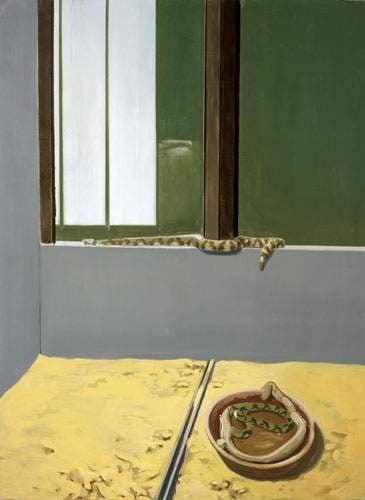
Analisi esperta di Serpents et assiette di Gilles Aillaud
Stile: Contemporary Realism · Genere: animal painting
Expert Analysis of Serpents et assiette by Gilles Aillaud
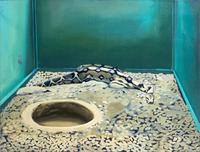
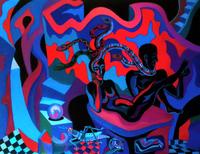
Gilles Aillaud’s Serpents et assiette (Snakes and Plate) stands as a compelling example of Contemporary Realism, a movement that emerged in the late 20th century as a critique of both abstraction and hyperrealism. Within this style, Aillaud’s work is significant for its unflinching, almost forensic depiction of animals in staged, often unsettling environments—a trademark that sets his animal paintings apart from traditional wildlife or naturalistic representation.
The painting operates as a quiet, dispassionate still life-meets-animal study. The “serpents” (likely one or more snakes) are shown alongside a mundane plate, a juxtaposition that strips the reptiles of symbolic menace or exoticism. Instead, Aillaud renders them with exacting, cool precision, emphasizing their physicality—scale texture, coiled tension, the sheen of skin—while the plate grounds the scene in a domestic, human context. This deliberate incongruity is a hallmark of Aillaud’s approach: he places animals in artificial, often cramped or sterile settings (zoos, glass cases, or, here, a tabletop) to highlight their captivity and the human gaze that objectifies them.
Within Contemporary Realism, Aillaud’s significance lies in his refusal to sentimentalize or mythologize his subjects. Serpents et assiette becomes a meditation on seeing and being seen, on the silent power dynamics between observer and observed. The plate—a vessel for human consumption—hints at the reduction of the animal to a specimen or decorative object, while the snakes’ coiled forms suggest a latent, controlled menace. The painting’s emotional restraint and meticulous observation align it with the “factual” side of the movement, yet its subtext critiques the very act of representation.
In the broader context of animal painting, Aillaud’s work is a radical departure from Romantic or naturalist traditions. He strips away narrative, beauty, and moralizing to present the animal as itself—alien, unknowable, and trapped within a human framework of looking. Serpents et assiette thus exemplifies how Contemporary Realism can use hyper-specific, objective description to generate profound philosophical unease, making it a key work for understanding late-20th-century art’s engagement with nature, captivity, and the politics of the gaze.
Visivamente simili
20 opere con composizione e palette affini
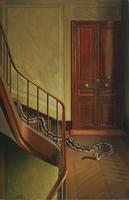
Danger on the Stairs
Pierre Roy
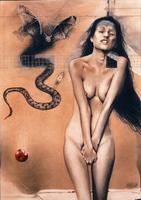
Untitled
Arturo Rivera
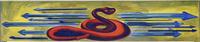
Panel 2. Snake and Spears - The Epic of American Civilization
Jose Clemente Orozco
Familie 0-Mittag
Matthias Weischer
Gold and Silver
Stanley Pinker
Serpentesques
Cricorps
Medusa
Carmen Delaco
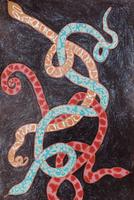
3 Serpent Qui Danse
Emma Odette
OTS1
Cricorps
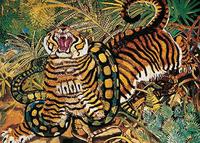
Roar
Antonio Ligabue
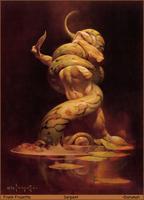
Serpent
Frank Frazetta
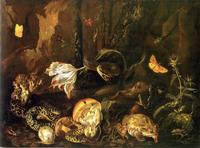
Still Life with Snakes, Frogs, Mushrooms, Flowers and Butterflies
Otto Marseus van Schrieck
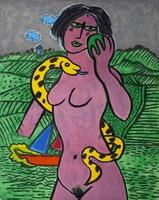
Eva
Corneille
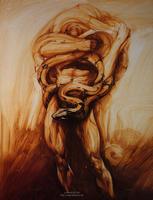
Laocoon
Wojciech Siudmak
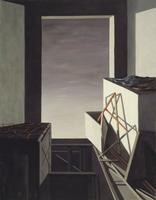
On the Contrary
Kay Sage
Serpent et trou
Gilles Aillaud
A Naturalist's Study
Pierre Roy
Blackamoor's Chamber. Fragment. Set Design
Alexandre Benois
A deadly care (The TASS Window №956)
Kukryniksy
Gorgon Medusa
Nina Tokhtaman Valetova