
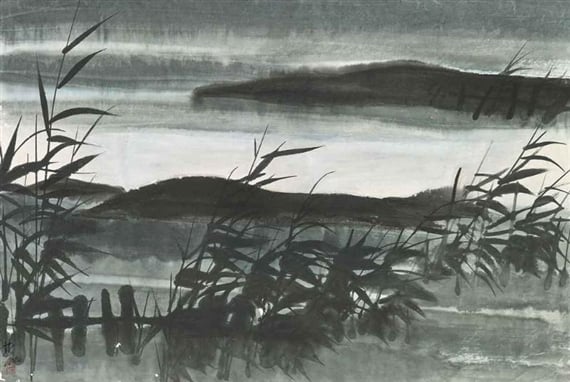
Reeds
Analisi esperta di Reeds di Lin Fengmian
Stile: Expressionism · Genere: landscape
Expert Analysis of "Reeds" by Lin Fengmian
Lin Fengmian’s "Reeds" stands as a pivotal work within the artist’s unique synthesis of Western Expressionism and traditional Chinese ink-painting aesthetics. While firmly rooted in the landscape genre, this painting transcends mere depiction of natural scenery to become an emotive, atmospheric meditation on transience and quietude.
Significance in Expressionism and Cross-Cultural Modernism
Lin Fengmian was a key figure in the early 20th-century Chinese modern art movement, studying in France and later returning to China to forge a new visual language. "Reeds" exemplifies his hallmark approach: retaining the Chinese preference for lyrical, poetic subject matter (such as reeds by water) while adopting the expressive, emotionally charged brushwork and bold, simplified forms of European Expressionism.
In this work, the reeds are not rendered with meticulous botanical accuracy. Instead, they are distilled into sweeping, rhythmic lines and gestural brushstrokes that convey motion—wind rustling through the marsh—and a melancholic, fleeting mood. The palette is deliberately restrained, often favoring muted earth tones, greens, and blues infused with a sense of atmospheric depth rather than optical realism. This aligns with Expressionism’s goal of evoking inner feeling over outer appearance.
What Makes It Significant
-
Fusion of Traditions: "Reeds" is a landmark of cultural hybridity. Lin borrows the angular, spontaneous brushwork of Chinese calligraphy and ink wash, but applies it to scenes depicted with the dramatic, subjective intensity of Expressionism. Ordinary reeds become vehicles for existential weight—a reflection of both Eastern longing (huai) and Western emotional directness.
-
Modernist Touch: Unlike traditional Chinese landscapes that emphasize vast, timeless spaces, Lin compresses the scene, focusing on the expressive pattern of the reeds themselves. The composition often suggests a cropped, almost abstract view, pushing the work toward modernist abstraction while retaining a recognizable subject.
-
Emotional Resonance: The significance also lies in how Lin uses the landscape to express personal and national identity. Painted during a period of political turmoil and artistic reform in China, "Reeds" can be read as a quiet, resilient statement of beauty and introspection amid chaos—a hallmark of Expressionist art’s power to channel social or personal anxiety through nature.
In summary, "Reeds" is not merely a landscape but a dialogue between two artistic traditions, a demonstration of how Expressionism can be reimagined through an Eastern lens, and a testament to Lin Fengmian’s role as a pioneer of modern Chinese art. Its significance endures because it shows that genuine artistic expression transcends cultural boundaries, transforming a humble reed bed into a universal symbol of grace and transience.
Visivamente simili
20 opere con composizione e palette affini
Untitled
Wu Guanzhong
Bamboo Groves in Mist and Rain (detail)
Guan Daosheng
Early Sumi-e
Alfred Freddy Krupa
Reeds and water lilies
Isaac Levitan
Sunset
Emil Nolde
Balaton
Goran Margetic
The Boathouse
Francis McMellon
The puddle
Alfred Krupa
Mountain
Utagawa Kuniyoshi
A boat at the river Korana
Alfred Freddy Krupa
Correnteza
Paula Klien
Dubovac
Alfred Freddy Krupa

Watercolor
Kazuo Nakamura
2014 04 10 17.07.05
Jimmy Ortiz
November First
Andrew Wyeth
Sound of thunder in the distance
Shitao
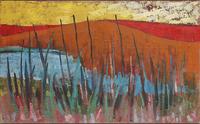
A Lake in the Middle of the Steppe
Vudon Baklytsky
Misty morning
Husnu Konuk
Scroll
Kanō Motonobu
Evening Glow at Mimizan
Winston Churchill