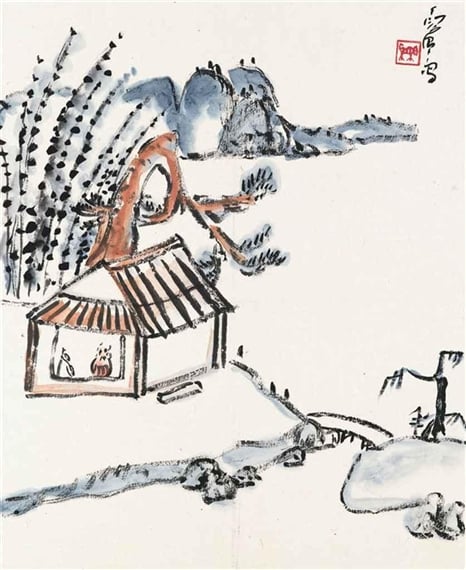
Conversations at a Retreat
Экспертный разбор работы «Conversations at a Retreat» художника Ding Yanyong
Стиль: Expressionism, Ink and wash painting · Жанр: landscape
Expert Analysis: "Conversations at a Retreat" by Ding Yanyong
Ding Yanyong’s “Conversations at a Retreat” stands as a landmark work within the modern Chinese ink tradition, exemplifying his pioneering fusion of Eastern literati painting with the bold expressiveness of Western Expressionism and Fauvism. The painting belongs to the landscape genre but transcends mere topography, using the retreat setting as a stage for emotional and spiritual dialogue.
Significance within Style and Period
As an artist who studied in Japan and France, Ding Yanyong broke decisively from orthodox Chinese academic painting. In “Conversations at a Retreat,” he employs the traditional medium of ink and wash but subverts its conventional restraint. The brushwork is loose, vigorous, and almost calligraphic in its spontaneity—yet it also carries the raw, color-driven energy of Expressionism. Rather than depicting a literal, serene landscape, Ding distorts forms and simplifies shapes to evoke the intimacy and psychological depth of human connection within nature.
The composition likely centers on figures in a secluded natural setting, their forms reduced to expressive strokes that communicate motion and feeling. The wash creates atmospheric depth not through graded ink tones alone, but through bold contrasts and unexpected placements—hallmarks of Ding’s ability to merge Chinese ink’s “spirit resonance” (qiyun) with Western modernism’s subjective intensity.
What Makes It Significant
-
Cultural Synthesis: This work is a masterful example of guohua (national painting) reform in the early 20th century. Ding Yanyong rejected both slavish imitation of the past and wholesale Westernization. Instead, “Conversations at a Retreat” achieves a bilingual visual language—the ink remains Chinese, but the emotional immediacy is thoroughly modern.
-
Expressive Innovation: In traditional ink landscape paintings, human figures are often small and subordinate to nature. Ding reverses this: the conversational figures become the emotional core, their gestures and postures emphasized through exaggerated, Expressionist strokes. The retreat setting is not a passive background but an active participant in the scene, its trees, rocks, and water rendered with an almost feverish vitality.
-
Legacy in Modern Chinese Art: Ding Yanyong’s approach directly influenced later generations of Chinese ink artists who sought to balance national identity with global modernism. “Conversations at a Retreat” embodies this dual commitment, proving that ink and wash could carry the raw subjectivity of Expressionism without losing its ancient heritage.
In summary, this artwork is significant as a bold synthesis of two seemingly incompatible traditions—the introspective poetry of Chinese ink painting and the visceral freedom of Expressionist gesture. It redefines the landscape genre as a space not for serene contemplation alone, but for the charged, living exchange between people and their environment.
Визуально похожие
20 работ с близкой композицией и палитрой
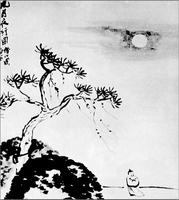
Cold Night
Qi Baishi
Landscape (Juran Style)
Bada Shanren
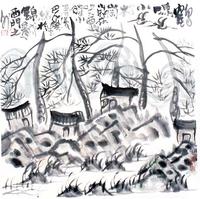
Cranes Crying in the Pine Grove
Li Huasheng
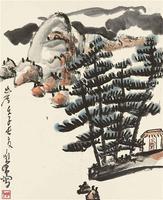
Tranquility in the Forest
Ding Yanyong
Trees
Qi Baishi
Cypresses
Qi Baishi
Sound of thunder in the distance
Shitao
Landscape (Dong Yuan and Juran Style)
Bada Shanren
Landscape
Tomioka Tessai
Sketch on a Summer Day
Li Huasheng
Landscape (Album Leaf)
Bada Shanren
A friend of solitary trees
Shitao
Mountain
Utagawa Kuniyoshi
Suhasiokdo
Shin Yoon-bok
Untitled
Shen Zhou
Sakanoshita: the Throwing Away the Brush Peak
Hiroshige
Twilight Pines
Qi Baishi
On the other side of the water
Shitao
Hamlet in the autumn mist
Shitao
Untitled
Shen Zhou