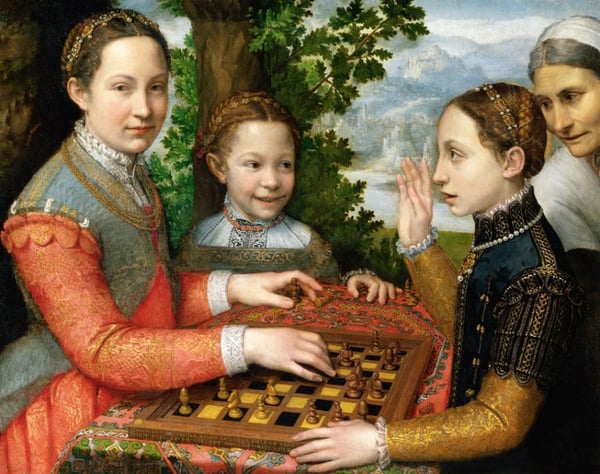
Lucia, Minerva and Europa Anguissola Playing Chess
Details
Description
Stijl: Mannerism (Late Renaissance) · Genre: genre painting
Possibly Anguissola's most recognisable work, The Chess Game is an intimate insight into the domestic, female world of sixteenth century Italy. Three young girls can be seen playing chess in the foreground, while an older woman, perhaps the Anguissola family's maid, is sitting behind them and watching their game. On the left, the artist's younger sister, Elena, gazes calmly towards the viewer while her hands indicate that she has just defeated her sister who sits on the right. Minerva, with her hand raised in defeat and disbelief, gazes with parted lips at the conqueror. The youngest girl, Europa, stands beside Elena and grins cheekily at the despondent loser. Her laughing expression recalls the drawing of the laughing girl in Boy Bitten by a Crawfish that Michelangelo had so admired, and perhaps this was Anguissola's sly way of immortalising her praised work. The painter has masterfully captured the details in the elaborate clothing of her sisters, using her pigments to highlight the braids wrapped around their heads, or the ruffled collars under their chins.
Through her paintbrush Anguissola has transformed a mundane, everyday interaction between sisters into drama. She used the scene to depict a number of artistic genres and skills including landscapes, fabric textures, and the human face at different stages of life, perhaps to highlight the scope of her talent. The landscape and detail on the oak tree behind the girls display her skill at depicting flora, while the chessboard and table with its Turkish carpet that butts up against the frame and into the viewer's space is not only showcasing her power in depicting still life but also seems to have influenced the later painter, Caravaggio, who often used jutting elbows, table corners and dirty feet to protrude into his audience's space.
As a woman in Renaissance Italy, it was thought to be too indecent for her to study the naked human form from life, and so the grander historical paintings or Biblical portraits such as St Sebastian, Adam and Eve or the death of Caesar were considered too racy. Thus, many of Anguissola's earlier work focuses on family members and self-portraits. But, like in this case, the subject is often given an unexpected dimension: her sisters here play a game of skill and strategy that hints at their intellectual potential.
Museum / Gallery
Visueel vergelijkbaar
20 werken met verwante compositie en kleurenpalet
the Game of Chess
Lucas van Leyden
Magdalena and Jan-Baptist de Vos, Children of the Painter
Cornelis de Vos
The Cheat with the Ace of Diamonds
Georges de la Tour
Judith with the head of Holofernes
Lucas Cranach the Elder
Die Schachpartie
Pieter Alardus Haaxman
Mary Magdalene
Jan van Scorel
Ritratto delle principesse d' Austria
Anton Graff
Portret Van Willem III, Prins Van Oranje, En Maria, Prinses Van Oranje, Als Kinderen
Gerard van Honthorst
The children of King Christian II of Denmark, Norway and Sweden
Mabuse
The Game of Draughts
Mattia Preti
Card Players
Lucas van Leyden
The Habert de Montmort Children
Philippe de Champaigne
Portrait of Giovanni della Volta with his Wife and Children
Lorenzo Lotto
The Procuress
Lucas Cranach the Elder
The Lavergne Family Breakfast
Jean-Étienne Liotard
Bianca degli Utili Maselli, holding a dog and surrounded by six of her children
Lavinia Fontana
An unknown Flemish Family
Otto van Veen
A Young Princess (Dorothea of Denmark)
Mabuse
Woman Weighing Gold
Jan van Hemessen
The Refreshment
Gerard Terborch