
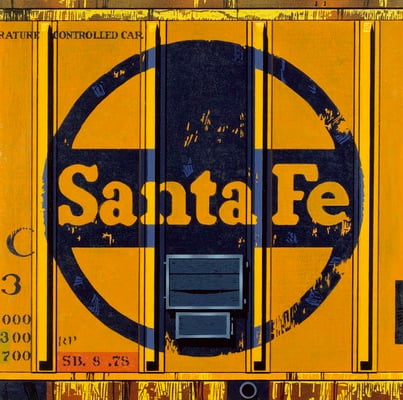
Analisi esperta di Santa Fe di Robert Cottingham
Stile: Photorealism · Genere: cityscape
Robert Cottingham’s "Santa Fe" is a quintessential work of Photorealism, a movement that emerged in the late 1960s and 1970s as a rigorous counterpoint to Abstract Expressionism and Pop Art. Cottingham, alongside artists like Richard Estes and Ralph Goings, specialized in rendering the visual language of the American urban landscape—particularly its signs, shopfronts, and architectural details—with near-photographic precision. This painting is significant for several reasons:
-
Subject as Icon: Rather than depicting the iconic landscape of the American Southwest, Cottingham focuses on the word “SANTA FE” itself—most likely a sign or a portion of a building facade. By isolating and magnifying this piece of commercial typography, he transforms a mundane element of the roadside environment into a monumental, almost abstract emblem. This mirrors the Photorealist interest in the sign as both a literal object and a symbol of American place and identity.
-
Formal Mastery of Light and Surface: Cottingham was celebrated for his ability to capture the interplay of reflective surfaces, metallic edges, and atmospheric light. In “Santa Fe,” the crisp lettering likely interacts with glass, metal, or painted brick, creating a complex play of highlights and shadows. The precise, airbrushed handling of gradients and reflections gives the surface a hyperreal, immaculate quality—one that paradoxically feels more vivid than a photograph.
-
Compositional Tension: The composition often crops the subject in a way that emphasizes the graphic abstraction inherent in the real scene. The diagonal or vertical lines of the sign, the repetition of shapes, and the carefully controlled depth of field (characteristic of Cottingham’s work) create a dynamic balance between literal representation and formal abstraction. This is not a passive window onto a street but a deliberate, almost architectural composition.
-
Photorealism’s Core Tension: A key significance of “Santa Fe” lies in how it embodies the Photorealist paradox: the work is based on a photograph—and thus seems “objective”—yet the artist’s meticulous hand selection and amplification infuse it with a cool, detached, yet hypnotic aura. Cottingham’s paintings do not simply replicate reality; they distill the visual noise of the built environment into an ordered, meditative experience.
-
Cultural Resonance: Santa Fe is a name loaded with associations of the American West, Route 66, and tourist iconography. By choosing this specific word, Cottingham taps into a collective visual memory. The painting becomes both a specific document of a particular time and place and a universal signifier for the way we experience the world through signage and commercial imagery.
In short, “Santa Fe” is significant because it elevates the humble, mass-produced street sign to the status of high art, while simultaneously demonstrating the technical virtuosity and conceptual rigor that define the best of Photorealist painting. It is a meditation on seeing, surface, and the American vernacular.
Visivamente simili
20 opere con composizione e palette affini
Freight Car at Truro
Edward Hopper
Night Robbery of a Carriage with Humanirtarian Aid from Red Cross
Ivan Vladimirov
Great Northern
Robert Cottingham
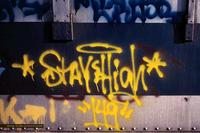
Tag
Stay High 149

Train In Landscape
Jeffrey Smart
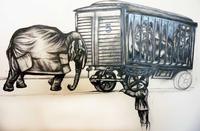
Topsy
Sue Coe
Postal de un Blues en A
Martin Pereira
Aubade
Mark Rothko
Jim Beam - J.B. Turner Train
Jeff Koons
Three Men
Ben Shahn
Richmond, California
Dorothea Lange
Mojave Bus Station
John Register
The Good Soldier Švejk
John Heartfield
Loneliness
Paul Delvaux
Gasometer in Vorortbahn
Ernst Ludwig Kirchner
In the perspective
Alfred Freddy Krupa
Wagon Bar
Cassandre
The Edge of Chaos : Time
Sami Gattoufi
Loading recently mined coal in Jenkins
Ben Shahn
End of an Era
Richard Whitney