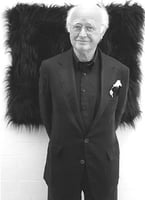
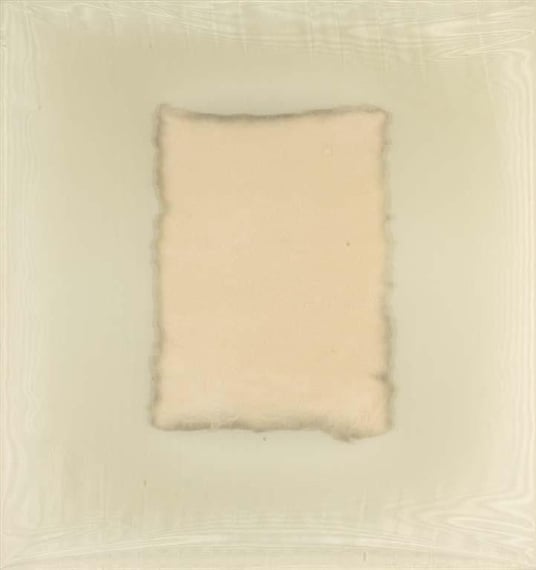
Expert analysis of Henk Peeters’s 61-26
Style: Nouveau Réalisme · Genre: abstract
Henk Peeters’ 61-26 (1961) exemplifies the radical material experimentation central to Nouveau Réalisme, a movement that sought to capture the “real” through the direct appropriation of everyday substances rather than traditional painting or sculpture. As a founding Dutch member of the group (alongside artists like Yves Klein and Arman), Peeters rejected both gestural abstraction and figurative narrative, instead elevating humble, industrial, or organic materials into the realm of fine art.
Significance within Nouveau Réalisme and Abstract Art:
-
Material as Subject: True to the movement’s manifesto, 61-26 is not painted but constructed—likely using felt, cotton, or other soft, non-precious fibers. Peeters often scorched, dyed, or layered such materials, preserving their tactile, unaltered presence. This work’s abstract composition is entirely derived from the physical properties of the material: its color, texture, and organic edges. There is no illusionistic space; the object is the reality it represents.
-
Challenging Abstraction’s Conventions: While the genre is “abstract,” it subverts the era’s dominant Abstract Expressionism or Color Field painting. Instead of expressing inner emotion through brushwork, Peeters presents a “ready-made” abstraction—one that exists in the world as a found or manipulated object. This aligns with Nouveau Réalisme’s goal of merging art with everyday life, turning a piece of industrial felt into a Minimalist-yet-sensuous statement.
-
Seriality and Time: The title 61-26 suggests a serial numbering system, typical of Peeters’ practice. He produced multiple similar works in 1961, each a unique variation on a theme. This systematic approach reflects the movement’s fascination with mass production and the anonymous, while the abstract forms retain an organic, almost burned or weathered character—hinting at transience and destruction as part of the real.
In summary, 61-26 stands as a pivotal work that uses abstraction not as escape from reality, but as a direct, material confrontation with it. Peeters’ choice of humble fabrics and his refusal to manipulate them into representational shapes make the piece a key document of Nouveau Réalisme’s attempt to redefine “realism” for a consumer age.
Genre
Style
Visually similar
20 works with related composition and palette
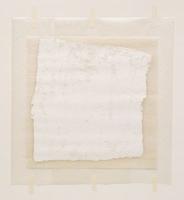
Surface Veil
Robert Ryman
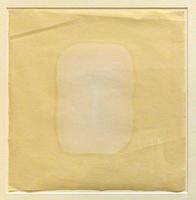
Untitled
Gotthard Graubner
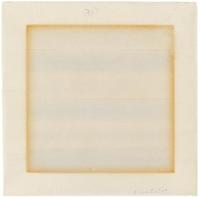
Untitled
Agnes Martin
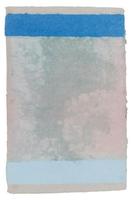
Horizontal Stripes I-1
Kenneth Noland
Infinity Field (Lefkada Series)
Theodoros Stamos
Infinity Field (Lefkada Series)
Theodoros Stamos
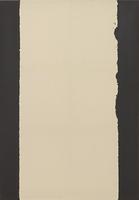
Burnt Umber & Ultramarine Blue
Yun Hyong–keun
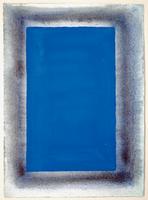
"Closed Window"
Kosakov Dimitrij
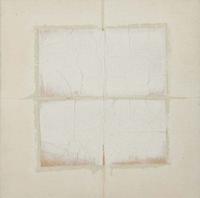
Depli blanc I
Jean Degottex
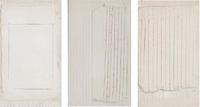
Bris-signe
Jean Degottex
Untitled
Jef Verheyen
Hydra Group X
Brice Marden
Volume a moduli sfasati
Dadamaino
Untitled
Brice Marden
Lemon Cards #1
Walter Darby Bannard
Dialogue 10
Vasile Dobrian
Spazio Luce
Antonio Calderara
Untitled
Brice Marden
Untitled
Brice Marden
Untitled
Marc Vaux