Expert analysis of Willem van Genk’s Zelfportret zwakzinnigennazorg
Style: Outsider art · Genre: self-portrait
Analysis of "Zelfportret zwakzinnigennazorg" by Willem van Genk
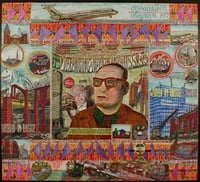
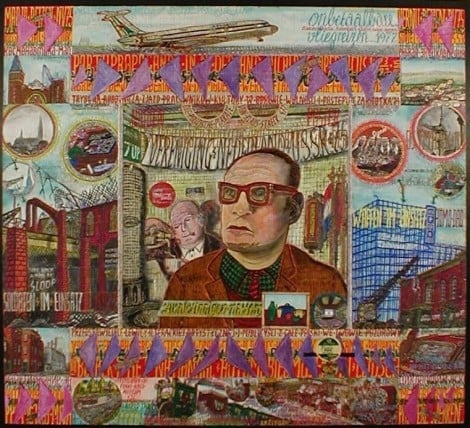
This self-portrait by the Dutch outsider artist Willem van Genk is a striking and deeply personal work that underscores the raw, unfiltered vision characteristic of Outsider art. The title, which translates to "Self-portrait care for the mentally ill," immediately situates the piece within a biographical and institutional context: van Genk was diagnosed with schizophrenia and spent long periods in psychiatric care. This painting is significant not merely as a likeness but as a defiant assertion of identity from within a system that sought to categorize and control him.
Stylistic Significance
Van Genk is best known for his obsessive, intricately detailed cityscapes and transportation networks—trams, buses, and train stations rendered with a near-cartographic precision. In this self-portrait, that same meticulous, linear intensity is turned inward. The figure is frontally posed, with a stiff, almost hieratic composure. The background may feature grid-like or architectural elements—a nod to his signature urban motifs—suggesting that even in self-representation, the artist's mind is inhabited by the ordered chaos of city infrastructure. The palette is often stark, with bold outlines and areas of unmodulated color, a hallmark of Outsider art's independence from academic tradition.
What Makes It Significant
-
Autobiographical Confrontation – The title directly references "zwakzinnigennazorg" (care for the mentally weak/disabled), a term carrying the stigma of his era. Van Genk reclaims this label, making the artwork a powerful statement of self-identification and resistance to dehumanizing institutional narratives. It is a rare instance in his oeuvre where he explicitly frames his mental health condition.
-
Contrast with His Subject Matter – Most of van Genk's work channels his inner world through external structures (trams, stations, world cities). Here, he turns the same obsessive eye onto his own face, bridging the gap between the systematic and the personal. This makes the portrait a key piece for understanding how he saw himself within the ordered systems he so meticulously drew.
-
Outsider Art's Unmediated Voice – The work lacks the conventions of polite portraiture: no softening of features, no psychological depth achieved through chiaroscuro. Instead, it presents a frontal, almost confrontational gaze. This directness is precisely what makes Outsider art powerful—it comes from an artist operating outside the mainstream, driven by inner necessity rather than market or academic expectations.
In sum, "Zelfportret zwakzinnigennazorg" is significant because it compresses van Genk's biography, his distinctive visual language, and the very ethos of Outsider art into a single, unflinching image. It is a self-portrait that does not seek to flatter or explain, but simply to declare: I am here, and I see myself.
Genre
Style
Visually similar
20 works with related composition and palette
Self Portrait in the Ark
Willem van Genk
Microcollage
Willem van Genk
Who will defeat whom
Aleksandr Deyneka
50 Jaar Soviet-Unie
Willem van Genk
Portrait of Luis Bunuel
Salvador Dali
For John Kane
Robert Qualters
Under condition of full co-operation
Konstantin Yuon
Group Portrait
Biruta Baumane
GEN001
Willem van Genk
Parnasky Culture
Willem van Genk
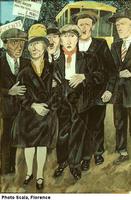
Demonstration in Paris
Ben Shahn
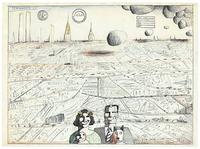
Utopia
Saul Steinberg
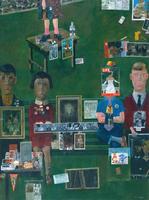
On the Balcony
Peter Blake
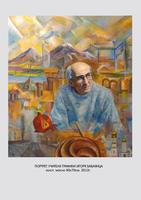
ПОРТРЕТ УЧИТЕЛЯ ГРАФИКИ
Vlad Avanesov
Retrato de Mario de Andrade
Lasar Segall
Auto Retrato
Alberto da Veiga Guignard
Peoples of the USSR before and now (old and new life in Central Asia)
Boris Kustodiev
Scheiber Hugó Önarckép,. ,
Scheiber Hugó
For the People 'We are Still Fighting'
Carlos Almaraz
GOELRO (Lenin s Plan for the Electrification of Russia)
Pavel Filonov