Analisi esperta di Figure in Motion di Willi Baumeister
Stile: Abstract Art · Genere: abstract
Expert Analysis: "Figure in Motion" by Willi Baumeister
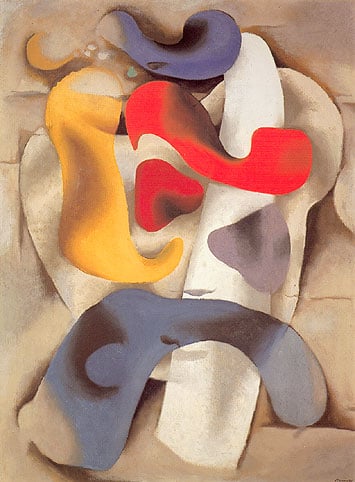
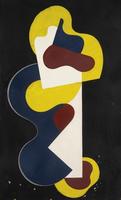
Willi Baumeister’s "Figure in Motion" is a compelling example of mid-20th-century European abstraction, situating the artist as a bridge between the Bauhaus tradition and the post-war search for a universal visual language. While the work’s title suggests a representational subject, Baumeister radically dissolves the human figure into a dynamic interplay of form, color, and gesture, aligning it with his broader commitment to "abstracted reality."
Significance within Abstract Art
Baumeister’s significance lies in his unique synthesis of biomorphic abstraction with a deep reverence for prehistoric and archaic art. In "Figure in Motion," this manifests as a reduction of anatomy to fluid, curvilinear shapes that evoke the energy of a body in transit without literal depiction. The composition likely balances tensile, organic forms against a restrained palette (common in his output from the 1930s–1950s), creating a sense of rhythmic oscillation—an optical equivalent of movement itself.
Unlike purely geometric abstractionists (e.g., Mondrian) or gestural Abstract Expressionists (e.g., Pollock), Baumeister pursued a "spiritual" abstraction rooted in archetypal symbols. "Figure in Motion" thus functions as a modern hieroglyph, referencing both cave paintings (which Baumeister studied extensively) and the dynamism of modern dance or machinery. This layered reference system makes the work significant as an early instance of abstraction that retains a tactile, almost archaeological connection to the human form.
Technical and Theoretical Context
As a former Bauhaus student and teacher, Baumeister embraced the school’s emphasis on material experimentation. In "Figure in Motion," one can infer a method akin to his "sand-painting" technique (applying pigment onto textured grounds), which gives the figure a grainy, primordial surface—further dissolving the boundary between object and space. This approach prefigures later Art Informel and European Tachisme, marking Baumeister as a transitional figure who moved from Bauhaus functionalism toward a more lyrical, mythic abstraction.
Legacy
"Figure in Motion" epitomizes Baumeister’s lifelong project: to distill the essence of movement and humanity into a timeless, non-narrative visual language. In doing so, it challenges viewers to perceive motion not as a physical occurrence but as a psychological and spatial state—a contribution that remains central to the history of abstraction’s expansion into the realm of the organic and the archaic.
Genere
Stile
Visivamente simili
20 opere con composizione e palette affini
Mask 4
Willi Baumeister
Seated Lovers
Carloluigi Colombo
Still Life with Self Portrait
Carloluigi Colombo
Un Bel Été 100 X 100 Cm 2020 G TROUBAT
Georges Troubat
Reclining Nude
Carloluigi Colombo
Mystere vert
Alberto Magnelli
Lemon
Juan Gris
Figura nello spazio I
Enrico Prampolini
X Ray Soldier's
Carloluigi Colombo
Two Lovers
Carloluigi Colombo
Study for a Painting
Ad Reinhardt
Free & Easy
Frederick Hammersley
Bodegón Cubista
Maria Blanchard
Naturaleza Muerta
Maria Blanchard
Wild Beast Roaming around the World
Peter Busa
Harbor of Ravenna
Carloluigi Colombo
Bild no. 84
Jacoba van Heemskerck
Sailboats
David Kakabadze
Composition Tight Curves. 25
Carl Buchheister
Dinner
Carloluigi Colombo