Expert analysis of Willi Baumeister’s Tennis Players
Style: Constructivism, Cubism · Genre: figurative
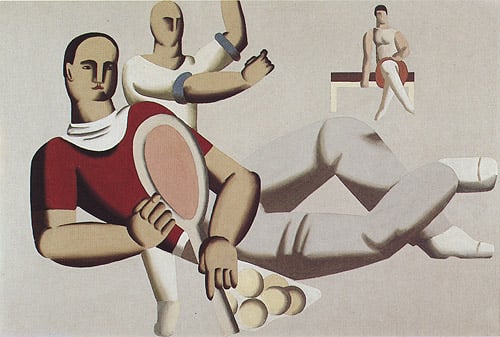
The significance of Willi Baumeister's Tennis Players lies in its synthesis of Constructivist geometry with Cubist fragmentation, applied to a dynamic figurative subject. As a work bridging two pivotal early‑20th‑century movements, it demonstrates how Baumeister translated the rigors of Constructivism—emphasizing line, plane, and rhythm—into the representation of motion and human form. The Cubist influence appears in the faceted, overlapping treatment of the players and the court, breaking down figures into angular, interlocking shapes that convey speed and competitive tension. By retaining a recognizable figurative core, Baumeister avoids pure abstraction, instead offering a modernist vision where sport becomes a vehicle for exploring spatial relationships and mechanical energy. This blending was characteristic of his transitional period, and Tennis Players stands as a key example of how Constructivist principles could animate—rather than dissolve—figurative art.
Visually similar
20 works with related composition and palette
Le tennis
Charles Lapicque
Tennis
Howard Arkley
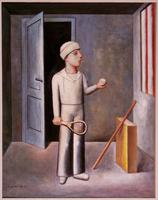
Il Figlio del Costruttore
Carlo Carra
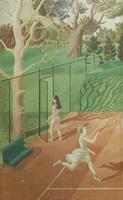
Tennis (triptych, left wing)
Eric Ravilious
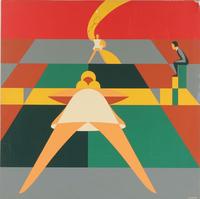
Tennis Match
John Vassos
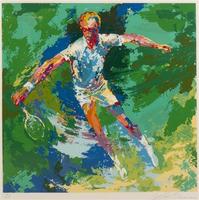
Stan Smith
LeRoy Neiman

Three women with flowers
Fernand Leger

Female Runner II
Willi Baumeister
Play
Marcel Duchamp
Tennis (triptych, right wing)
Eric Ravilious
Mask. For the Ballet Studio of B.Nizhinskaya
Vadym Meller
The Bathers
Fernand Leger
Venus and Sailor
Salvador Dali
Lawn-tennis
Cassandre

Tennis (triptych, centre panel)
Eric Ravilious

A three-handed game
Danil Nemirovsky
Reclining Nude
Yiannis Moralis

Bortnyik Sándor, Strand Dáma.
Sandor Bortnyik

The Blue Robe
Will Barnet

Abstract Design of a Mountanous Landscape
John Vassos