Экспертный разбор работы «Piece LXXXII» художника Anthony Caro
Стиль: Abstract Art · Жанр: sculpture
Expert Analysis of Piece LXXXII by Anthony Caro (Abstract Art, Sculpture)
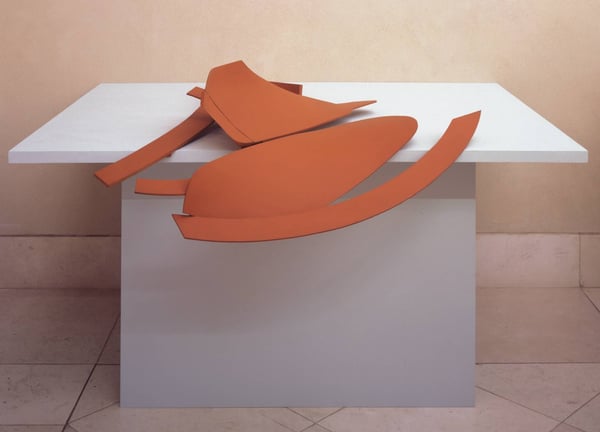
Anthony Caro’s Piece LXXXII is a landmark work within the tradition of abstract sculpture, emblematic of his revolutionary approach to form, material, and spatial engagement. As a leading figure in post-war British sculpture, Caro rejected the monolithic, figurative traditions of his predecessors (notably Henry Moore) and instead embraced industrial materials, bold color, and an open, horizontal relationship with the viewer’s space.
Significance within Abstract Art and Caro’s Oeuvre:
- Ground-Breaking Relationship to Space: Unlike traditional sculpture that rests on a pedestal, Caro placed his works directly on the floor, forcing the viewer to encounter them as physical presences in real, shared space. Piece LXXXII likely exemplifies this: its beams, planes, and lines extend outward, defining and interacting with the surrounding environment rather than dominating it.
- Industrial Materiality: Caro used rolled steel, I-beams, and off-the-shelf metal parts, often painted with commercial-grade pigments. The raw, unadorned surfaces of Piece LXXXII celebrate the intrinsic qualities of steel—its weight, tensile strength, and potential for linear precision—while the paint (frequently a single hue) unifies the disparate elements and suppresses representational associations, pushing the work toward pure abstraction.
- Focus on Line and Gesture: Caro’s sculptures are often described as “drawings in space.” In Piece LXXXII, thin rods, flat sheets, and angled supports likely create a sense of rhythmic, spontaneous movement, as if the metal has been wielded like a brushstroke. This emphasis on line over mass aligns with Abstract Expressionist painting, yet Caro translates that energy into three dimensions.
- Rejection of Iconic Symbolism: The numbered title (Piece LXXXII) deliberately avoids narrative or symbolic reference. Caro insisted that his sculptures be experienced purely as physical, visual events—shapes that activate perception and bodily awareness through their arrangement of tension, balance, and interval.
Influence and Legacy:
Piece LXXXII embodies the radical shift that Caro catalyzed in the 1960s, influencing Minimalist and Post-Minimalist sculptors (e.g., Richard Serra, Robert Morris). It asserts that sculpture can be abstract without being static, industrial without being cold, and monumental without being grand. The work’s significance lies in its ability to make the viewer conscious of their own body in relation to the object—a dialog that remains central to contemporary three-dimensional abstraction.
In summary, this sculpture is significant not for what it represents, but for how it compels us to see, move, and think with space and material. It is a pure exercise in form that redefined the possibilities of modern sculpture.
Визуально похожие
20 работ с близкой композицией и палитрой
Cohesion VII
Hans Richter
Table Piece CCLXVI
Anthony Caro
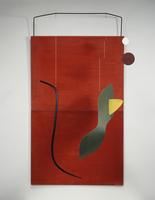
RED PANEL
Alexander Calder
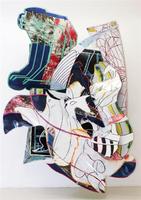
The Mat-Maker
Frank Stella
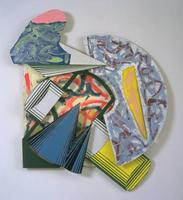
Salta nel mio Sacco
Frank Stella
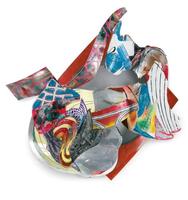
The Musket
Frank Stella
Untitled
Tea Jorjadze
Magritte's Stone
Noguchi Isamu
Bichos
Lygia Clark
WHITE PANEL
Alexander Calder
UNTITLED [MAQUETTE]
Alexander Calder
Chunk
Richard Serra
Pizzicato
Charles Hinman
Form against Yellow (Yellow Panel)
Alexander Calder
Lift
Elspeth Pratt
Chehaw
Sam Gilliam
Sail Shape
Noguchi Isamu
Lost Space
Guy Mees
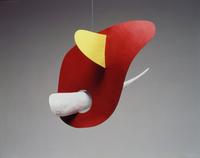
ELEPHANT
Alexander Calder
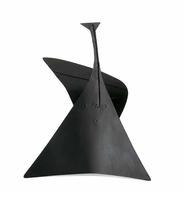
LITTLE ARCH [MAQUETTE]
Alexander Calder