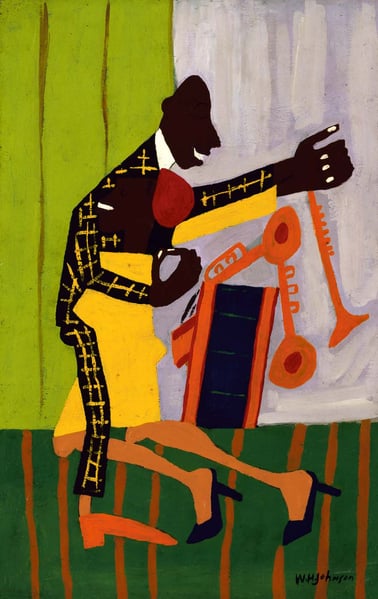
William H. Johnson の Jitterbugs (II) の専門的な分析
スタイル:Naïve Art (Primitivism) · ジャンル:genre painting
Expert Analysis: "Jitterbugs (II)" by William H. Johnson
Style & Movement Significance
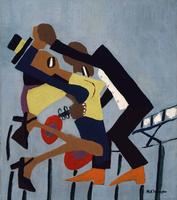
William H. Johnson’s Jitterbugs (II) is a quintessential example of Naïve Art (or Primitivism), a style that deliberately rejects academic realism in favor of simplified forms, flat planes of intense color, and a direct, unpretentious visual language. For Johnson, this approach was not mere stylistic choice but a powerful vehicle for cultural affirmation. After studying European modernism and living abroad, he returned to the United States and consciously adopted a folk-inspired, "primitive" manner to celebrate African American life and heritage. In this work, the jitterbug—a lively, syncopated dance born from the jazz age—becomes a symbol of resilience, joy, and community.
Genre Painting as Social Documentation
As a genre painting, Jitterbugs (II) captures a slice of everyday Black American life in the mid-20th century. Johnson transforms a social dance into a vibrant tableau: the exaggerated limbs, rhythmic repetition of figures, and bold outlines evoke the kinetic energy of the jitterbug itself. The composition eschews perspective, stacking dancers in a shallow space, which emphasizes the collective, communal experience over individual likeness. This flattening—typical of Naïve Art—also mirrors the syncopated rhythms of jazz, where melody and harmony interweave without traditional hierarchy.
What Makes It Significant
- Cultural Pride: Johnson uses a "primitivist" aesthetic not to exoticize but to center Black cultural expression. The jitterbug, often marginalized or caricatured in mainstream art, is here depicted with dignity and explosive vitality.
- Formal Innovation: The work’s bold, unmodulated hues—deep blues, fiery oranges, and stark blacks—create a visual pulse akin to musical improvisation. The simplified, almost childlike figures paradoxically convey sophisticated movement and emotion.
- Historical Context: Painted during the Harlem Renaissance’s later phase and Johnson’s own shift toward a personal folk style, Jitterbugs (II) represents a deliberate break from European-derived modernism to forge a distinctly African American visual vocabulary. It stands as a precursor to later movements that would embrace "outsider" or self-taught aesthetics.
In essence, Jitterbugs (II) is significant because it weds the expressive freedom of Naïve Art with the urgent documentation of Black cultural identity, turning a dance floor into a declaration of artistic and social agency.
視覚的に類似
構図やパレットが近い作品 20 件
Jazz Bakery
Jerry W. McDaniel
Scheiber Hugó. Kapaos Férfi
Scheiber Hugó
The musicians
Gino Severini
Untitled
Fikret Mualla Saygi
Metaphysical Figures, Sansepolcro
William Balthazar Rose
Untitled
Romare Bearden
Musicians with masks
Pablo Picasso
Untitled
James Weeks
Bessie, Duke, and Louis
Romare Bearden
AP 1921 Three Musicians 2019
Anthony Padgett
Jitterbugs (III)
William H. Johnson
Scheiber Hugó Jazz Band, 1940, Gouache, Pasztell, Paír, 70x50cm
Scheiber Hugó
Out Chorus
Romare Bearden
Chorinho
Candido Portinari
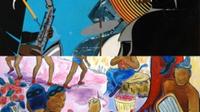
Jazz Rhapsody
Romare Bearden
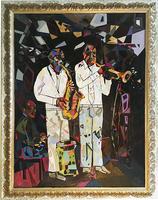
Maison de Bourbon
Shoosty
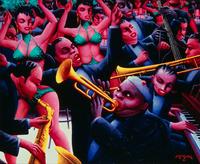
Hot Rhythm
Archibald Motley
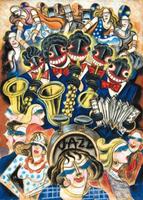
Scheiber Hugó, Muzsikusok
Scheiber Hugó
THE JAZZ BAND
Gerard Sekoto
Scheiber Hugó, Fuvósok
Scheiber Hugó