Expert analysis of William H. Johnson’s Still Life
Style: Cubism, Expressionism · Genre: still life
Expert Analysis: "Still Life" by William H. Johnson
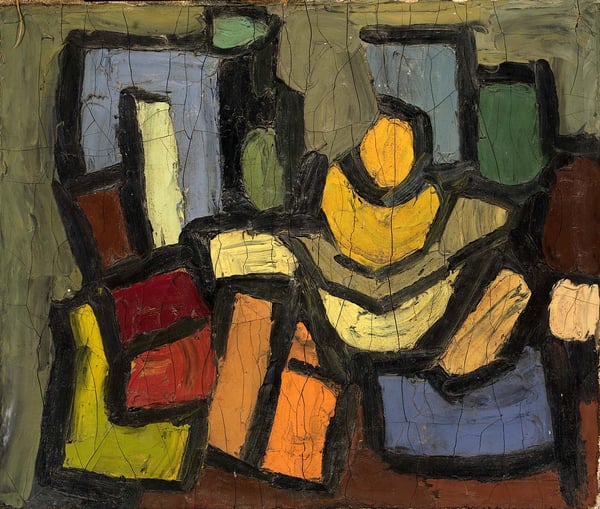
William H. Johnson’s Still Life stands as a compelling synthesis of two major early-20th-century movements—Cubism and Expressionism—channeled through the unique perspective of an African American modernist. Painted during a period when Johnson was deeply engaged with European avant-garde techniques (while studying and working in France and Scandinavia), this work demonstrates his ability to merge formal structural rigor with intense emotional color.
Significance within Cubism and Expressionism:
- Cubist Foundation: The composition breaks the traditional still-life objects—likely bottles, fruit, or tableware—into faceted, geometric planes. Johnson employs a restrained, earthy palette common to Analytical Cubism (browns, grays, ochres) but avoids monochrome austerity. The tilted tabletop and compressed space echo Picasso and Braque’s spatial distortions, yet Johnson’s forms are more rounded and less fragmented.
- Expressionist Intervention: Where Cubism often suppresses color for form, Johnson injects vivid, unnatural hues—deep blues, fiery reds, or acidic greens—pushing the still life into a realm of psychological intensity. The brushwork becomes energetic, even agitated, aligning with the German Expressionist emphasis on raw emotion over naturalistic representation. This duality marks Johnson’s Still Life as a hybrid, not merely an academic exercise in Cubism but a personal, emotive statement.
Art-Historical Significance: Johnson’s work is significant precisely because he refused to be confined to a single style or cultural identity. At a time when African American artists were often expected to produce only figurative, socially conscious work (as in the Harlem Renaissance), Johnson experimented boldly with European modernism. Still Life exemplifies his belief that abstraction and expressive distortion could be vehicles for both universal artistic language and—later in his career—his own cultural heritage. Though this piece predates his mature folk-inspired style, it already shows his tendency to simplify forms into graphic, almost quilt-like patterns, hinting at the flatness and rhythmic repetition that would define his later masterpieces.
Why This Artwork Matters: Still Life is a testament to Johnson’s role as a bridge between international modernism and American art. It challenges the narrative that African American artists of the 1930s-40s were only concerned with social realism or folk narratives. Here, Johnson proves that he could hold his own alongside European cubists while injecting a distinctly vibrant, personal energy. The painting’s significance lies in its fearless hybridity: it takes the intellectual puzzle of Cubism and fuses it with the visceral punch of Expressionism, creating a still life that is at once orderly and ecstatic, analytical and passionate. This duality makes Still Life a crucial work in understanding Johnson’s evolution and his often-overlooked contribution to the broader modernist canon.
Genre
Style
Visually similar
20 works with related composition and palette
Untitled
Maurice Esteve
Trees on a Cloudy Day
Vilen Barsky
Trees on a Cloudy Day
Vilen Barsky
Studio III
Gary Wragg
Untitled
Afro
La sella
Afro
Untitled
Andre Lanskoy
Sem título
Joaquim Rodrigo
Composition#7
Valerii Lamakh
Composition
Francis Bott
La soeur de la Violette
Andre Lanskoy
Evocation
Francis Bott
Формоутворення (Forming)
Артемій Присяжнюк
Untitled
Jean-Michel Atlan
Пробудження (Awakening)
Артемій Присяжнюк
Asklepois
Hans Hofmann
Mi.R Bb2
MAURIZIO D'ANDREA
Secretary
Willem de Kooning
De Visvangst
Corneille
Cin-Zin
Karl Knaths