Expert analysis of Janet Fish’s 4 Glasses
Style: Contemporary Realism · Genre: still life
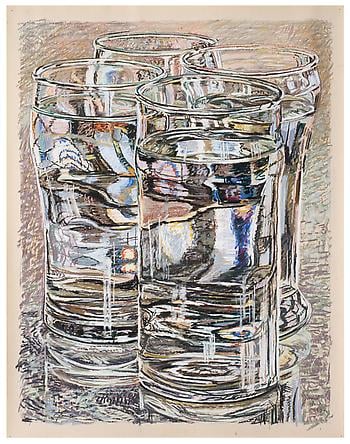
Janet Fish’s 4 Glasses is a masterful example of Contemporary Realism that reinvigorates the traditional still-life genre through its obsessive attention to light, transparency, and reflective surfaces. Working in an era when photorealism and abstraction often dominated, Fish instead embraced a lush, painterly realism that celebrates the optical complexities of everyday objects.
Significance within Contemporary Realism:
Fish belongs to a generation of artists who rejected both minimalism and conceptual art, choosing instead to ground their practice in direct observation. 4 Glasses epitomizes this commitment by transforming a humble subject—four drinking vessels—into a dazzling study of refraction, color, and spatial ambiguity. Where earlier still-life painters (like Chardin or the Dutch masters) used glass to convey moral or vanitas themes, Fish focuses purely on the visual and sensory experience: the way light bends through a stem, the kaleidoscopic reflections on a tabletop, the overlapping shadows that create an almost abstract pattern. This shifts the still life from a narrative or symbolic device to a vehicle for perceptual exploration.
Technical and Conceptual Innovation:
Fish’s handling of transparency and reflection is remarkable. She does not simply render glass as a series of highlights and outlines; instead, she builds it from patches of vivid, unexpected colors—pinks, blues, yellows—that represent the environment bouncing off the glass surfaces. This approach makes the glasses feel both solid and ethereal, grounded in reality yet vibrating with optical energy. The composition of four distinct glasses (likely varying in shape and size) creates a rhythmic interplay of forms: a goblet, a tumbler, or a wine glass might interact through their shared reflections, blurring boundaries between object and space. In doing so, Fish challenges the viewer to question what is actually “seen” versus what is an illusion—a quintessentially contemporary concern that allies her work with perceptual psychology and postmodern theories of vision.
Placement in Art History:
4 Glasses is significant because it proves that realism need not be nostalgic or academic. Fish’s bold use of color and her decision to crop the composition closely (often with only a sliver of table edge) align her with Modernist abstraction’s fragmentary framing, while her meticulous rendering grounds her in the tactile world. The work thus bridges the gap between representational tradition and contemporary formalism, demonstrating that everyday subjects can be just as radical and visually rich as any non-objective painting. In her hands, the lowly drinking glass becomes a prism through which we rediscover the beauty of light and perception—the very essence of why Contemporary Realism remains a vital force.
Genre
Style
Visually similar
20 works with related composition and palette
Glass
Oleksandr Hnylyzkyj
Wine and Cheese Glasses
Janet Fish
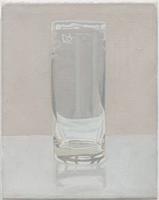
Day By Day, Good Day No. 0
Peter Dreher
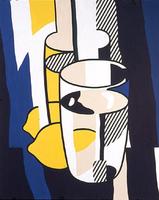
Glass and lemon in a mirror
Roy Lichtenstein
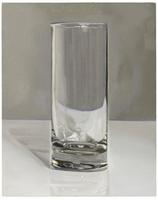
Day by Day, Good Day Nr. 382 (Night)
Peter Dreher
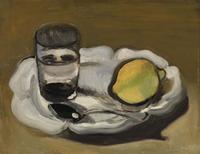
Still Life with Lemon
Henri Matisse
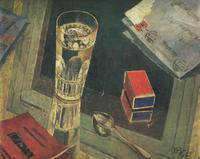
Still Life with Letters
Kuzma Petrov-Vodkin
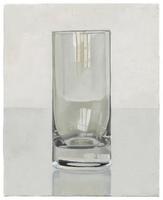
Day by Day, Good Day Nr. 2465 (Day)
Peter Dreher
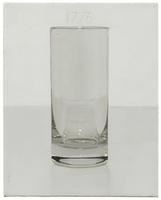
Day by Day, Good Day Nr. 1776 (Night)
Peter Dreher
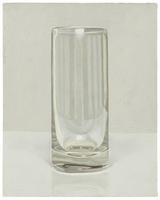
Day by Day, Good Day Nr. 14 (Night)
Peter Dreher
Day by Day, Good Day Nr. 1279 (Day)
Peter Dreher
Hexagram 63
Oleksandr Aksinin
Day by Day, Good Day Nr. 44 (Day)
Peter Dreher
Day by Day, Good Day Nr. 1552 (Night)
Peter Dreher
Aqua Minerale
Oleksandr Hnylyzkyj
Cup
Oleksandr Aksinin
Day by Day, Good Day Nr. 848 (Night)
Peter Dreher
Still Life with Newspaper
Juan Gris
Glass (from Paintings for an apartment)
Rafal Bujnowski
Day by Day, Good Day Nr. 668 (Day)
Peter Dreher