
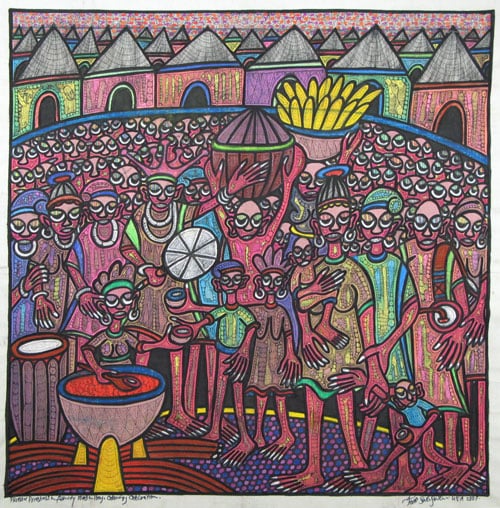
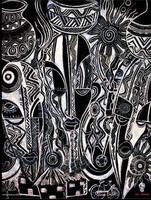
Priest and Priestess in Festivity Mood of Ibeji Ceremony
Details
Expertenanalyse zu Twins Seven Sevens Priest and Priestess in Festivity Mood of Ibeji Ceremony
Stil: Naïve Art (Primitivism) · Genre: genre painting
Expert Analysis: "Priest and Priestess in Festivity Mood of Ibeji Ceremony" by Twins Seven Seven
This vibrant genre painting by Nigerian master Twins Seven Seven—a leading figure of the Oshogbo art movement—exemplifies a distinctive fusion of Naïve Art (Primitivism) with deep Yoruba cultural symbolism. The work’s significance lies in how it transforms a traditional ritual into a densely patterned, ecstatic visual language that bridges folk spirituality and modernist expression.
Stylistic Significance within Naïve Art / Primitivism
Twins Seven Seven’s style deliberately rejects academic perspective and naturalism, embracing a flat, decorative surface that pulses with rhythmic linework and bold, unmodulated colors. This approach aligns with Primitivism’s romanticized “outsider” aesthetic, but here it is not a Western appropriation—it is an indigenous artist reinterpreting his own heritage. The intricate, labyrinthine patterns (often called “the undulating line”) fill every inch of the composition, creating a sense of fertility, movement, and spiritual energy. This technique, influenced by Yoruba textile design and body scarification, pushes Naïve Art beyond mere simplicity into a sophisticated, coded visual language.
Genre and Ceremony
As a genre painting, the work captures a specific cultural event: the Ibeji ceremony honoring twins, who hold sacred status in Yoruba belief. The priest and priestess are shown in “festivity mood,” their exaggerated gestures and intertwined forms suggesting ritual dance and communal joy. The title emphasizes that this is not a static portrait but a performance—a moment of spiritual exuberance. Twins Seven Seven transforms the mundane into the mythic; the figures’ elongated limbs and mask-like faces evoke ancestral spirits, while the crowded composition teems with symbolic motifs (birds, fish, plants) referencing fertility and continuity.
Period and Cultural Context
Created during the 1960s–70s golden age of Nigerian modernism, this work exemplifies the Oshogbo school’s mission to adapt traditional Yoruba iconography for contemporary art. Twins Seven Seven’s international recognition—including his inclusion in major exhibitions like the 1977 FESTAC—helped challenge Western hierarchies of “high” vs. “folk” art. Here, the Primitivist label is reclaimed: the painting’s raw energy and deliberate disregard for illusionism are not signs of naivety but of a conscious, revolutionary aesthetic. The work stands as a vibrant testament to how Naïve Art can serve as a vehicle for cultural preservation, spiritual expression, and modern artistic innovation.
Visuell ähnlich
20 Werke mit ähnlicher Komposition und Farbpalette
Arugba Osun
Twins Seven Seven
The Blessed Family
Twins Seven Seven
Ocean Blessed Family
Twins Seven Seven
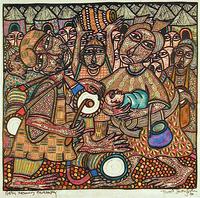
Baby Naming Ceremony
Twins Seven Seven
The Golden Mother
Twins Seven Seven
Blessed Fisherman Family and Golden Fish
Twins Seven Seven
Masked Ceremony
Twins Seven Seven
King and his Subjects
Twins Seven Seven
Mamy and Child - Village Life
Twins Seven Seven
The Woman Carrying Water
Twins Seven Seven
Mother of Fraternity
Twins Seven Seven
Composition With Figures
Mario Zanini
Palmwine Tapper and Family
Twins Seven Seven
Three Wise Ocean Gods: Air, Sea, Nature Controller
Twins Seven Seven
Villagers
Alfred Krupa
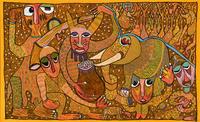
The Elephant Enticement
Twins Seven Seven
Retirantes
Candido Portinari
Sexteto
Sergio Hernández
Untitled
Rosemary Karuga
Untitled
Laolu Senbanjo