
Expertenanalyse zu Twins Seven Sevens The Palm Wine Tapper
Stil: Naïve Art (Primitivism) · Genre: genre painting
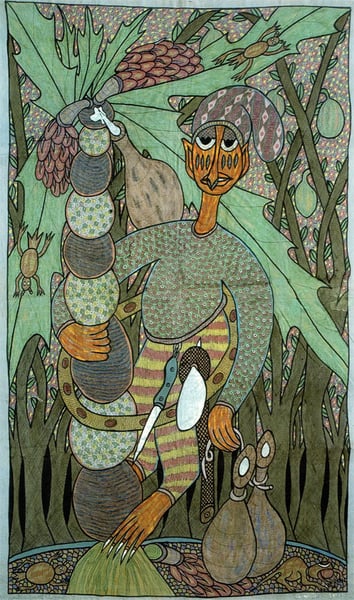
Expert Analysis of "The Palm Wine Tapper" by Twins Seven Seven
Twins Seven Seven (b. 1944, d. 2011) was a founding member of the Oshogbo art movement, a Nigerian school that emerged in the 1960s and drew heavily on Yoruba mythology, ritual, and folklore. His work is often classified as Naïve Art (Primitivism) — a label that captures its intuitive, self-taught origins and its departure from Western academic conventions—but it is more accurately understood as a vibrant, hybrid visual language that fuses traditional storytelling with modernist improvisation.
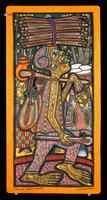
“The Palm Wine Tapper” is a genre painting in the sense that it depicts a common, everyday activity in rural West Africa: the harvesting of palm wine from a palm tree. But Twins Seven Seven transforms this mundane scene into a fantastical, densely patterned universe. The composition is characteristically all-over and rhythmic: the figures and vegetation interlock in a pulsating, decorative web, with no single focal point dominating the canvas. The tapper himself is often rendered in profile or distorted perspective, his body elongated and stylized—a hallmark of the artist’s work, which owes as much to Yoruba woodcarving and masquerade traditions as to the graphic verve of outsider art.
What makes this work significant within the Naïve Art (Primitivism) context is its radical rejection of Western naturalism in favor of an internally consistent, symbolic order. The palm tree is not a botanical study but a life-giving axis mundi; the tapper’s labor becomes a ritual act. Twins Seven Seven layers intricate patterns—zigzag lines, concentric circles, stippled dots, and cross-hatching—that recall both the scarification marks of Yoruba statuary and the graphic improvisations of European modernists like Paul Klee or Dubuffet. Yet the work never feels derivative. Instead, it asserts a uniquely African modernism, one that refuses the condescension of “primitivism” by claiming its own complex narrative and technical sophistication.
The painting’s significance also lies in its materiality. Twins Seven Seven often worked on plywood or hardboard, using natural inks, dyes, and ballpoint pens to achieve his characteristic saturated colors and intricate linework. This raw, handmade quality—combined with the exuberant, almost hallucinatory detail—places the work at the intersection of folk art, contemporary African art, and global modernity. “The Palm Wine Tapper” is not merely a charming scene; it is a manifesto for how cultural tradition can be reinvented with fierce originality, challenging the boundaries of Naïve Art and asserting Twins Seven Seven as one of Nigeria’s most visionary visual storytellers.
Visuell ähnlich
20 Werke mit ähnlicher Komposition und Farbpalette
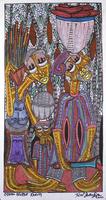
Ocean Blessed Family
Twins Seven Seven
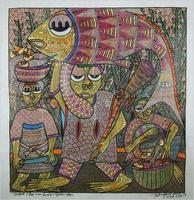
Blessed Fisherman Family and Golden Fish
Twins Seven Seven
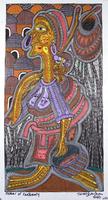
Mother of Fraternity
Twins Seven Seven
Vévé Voudou III
Beauford Delaney
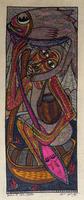
Dream of Fish Collector
Twins Seven Seven
The Pink Napkin
Georges Braque
Drapeau rigide aux couleurs inconnues
Jules Perahim
Village Farmer Woman Leader
Twins Seven Seven
Interrogation Site (Lieu d'interrogation)
Pierre Alechinsky
The Blessed Family
Twins Seven Seven
Palmwine Tapper and Family
Twins Seven Seven
Composition
Ion Alin Gheorghiu
Three Wise Ocean Gods: Air, Sea, Nature Controller
Twins Seven Seven
Christmas Tree
Frances Hodgkins
Composition II
Ion Alin Gheorghiu
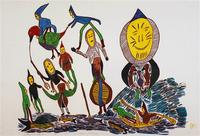
A Face like the Sun
Ruth Annaqtuusi Tulurialik
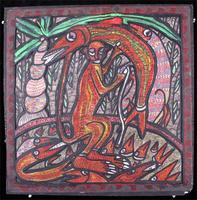
Monkey with Fish
Twins Seven Seven
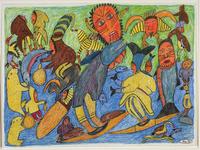
Fish Spirits Riding on Kayaks
Ruth Annaqtuusi Tulurialik
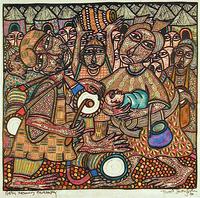
Baby Naming Ceremony
Twins Seven Seven
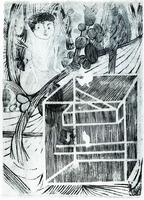
Gaiola I - do livro Menino de Engenho
Candido Portinari