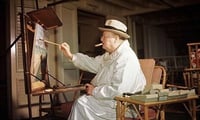
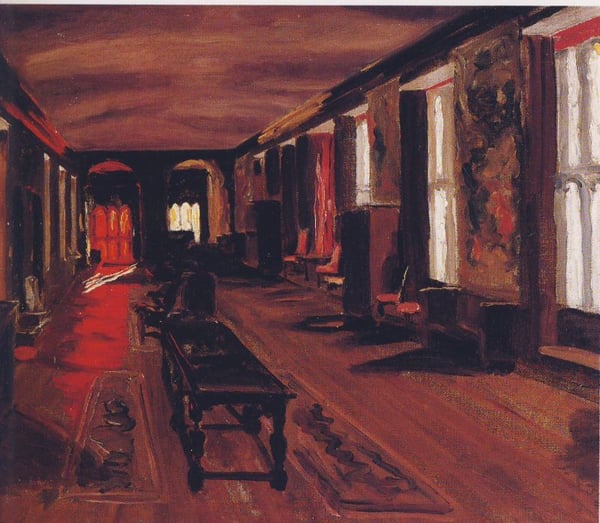
Long Gallery at Sutton Place, near Guildford
Expertenanalyse zu Winston Churchills Long Gallery at Sutton Place, near Guildford
Stil: Impressionism · Genre: interior
Expert Art Historical Analysis:
Winston Churchill’s “Long Gallery at Sutton Place, near Guildford” stands as a compelling example of the amateur yet highly accomplished Impressionist interior, offering a rare window into the painterly pursuits of one of the 20th century’s most towering political figures. Executed in Churchill’s signature impressionistic style, the work transforms a stately architectural space into a study of light, atmosphere, and fleeting visual sensation.
Significance within Impressionism and Churchill’s Oeuvre:
-
Interior as Atmospheric Vessel: True to Impressionist principles, Churchill does not simply depict the long gallery as a static architectural record. Instead, he captures the play of daylight filtering through windows, the soft diffusion of shadows, and the subtle modulation of color across walls and furnishings. The composition likely emphasizes the en plein air effect brought indoors—a hallmark of how Impressionist painters treated interiors as environments of shifting light, rather than rigid perspectives.
-
The Amateur’s Freshness: Churchill took up painting in his forties under the mentorship of artists like Walter Sickert and Paul Maze, adopting a direct, vigorous brushwork that retained a spontaneous, unpolished quality. In this gallery scene, that freshness is evident: broad strokes define the long perspective, while dabs of color suggest wood paneling, paintings on the walls, and the reflective gleam of polished floors. The lack of academic finish becomes a strength, conveying the immediacy of the artist’s visual impression.
-
Historical and Personal Context: Sutton Place (in Surrey, near Guildford) was the home of Churchill’s friend and patron, the financier and art collector Sir John Leigh. Painting this interior allowed Churchill to relax from his political burdens, particularly during the 1930s—his “wilderness years.” The work thus exemplifies his use of painting as a therapeutic and meditative practice, a dimension that deepens its significance beyond mere decorative art.
-
Interior as Psychological Space: The long gallery, with its receding lines and quiet elegance, functions as a metaphor for Churchill’s own need for retreat and contemplation. The choice of an interior, rather than a landscape (his more common subject), underscores a moment of stillness and introspection. The act of capturing the gallery’s atmosphere on canvas reflects Churchill’s belief that painting could “recall an emotion” and “fix a fleeting aspect of nature or of life.”
Conclusion:
Churchill’s “Long Gallery at Sutton Place” is significant not only as a charming Impressionist interior but as a document of how a statesman found solace in the artistic discipline of seeing light, color, and mood. It demonstrates that Impressionism, in the hands of a dedicated amateur, could serve as a powerful tool for personal expression and historical record, bridging the worlds of political power and aesthetic sensitivity.
Visuell ähnlich
20 Werke mit ähnlicher Komposition und Farbpalette
The Blue Room at Lympne
Winston Churchill
Interior of the Musée De Cluny
Louis Hayet
Interior, Oak Manor
William Merritt Chase
The Winter Dining Room of the Earl of Essex at Cassiobury
William Henry Hunt
A Room at Breccles, Norfolk
Winston Churchill
The Long Gallery, Hardwick Hall, Derbyshire
David Cox
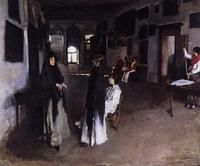
A Venetian Interior
John Singer Sargent
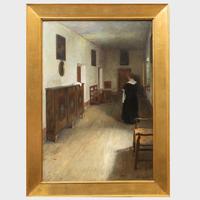
Rumisinterior
Bertha Wegmann
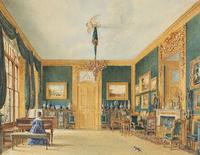
he Green Drawing Room of the Earl of Essex at Cassiobury
William Henry Hunt
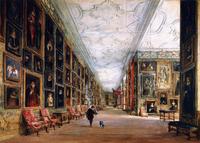
The Long Gallery, Hardwick Hall, Derbyshire
David Cox
Interior
Carl Henrik Nordenberg
The Italian Room, 42 Hyde Park Gate, London
Richard Jack
Wystawa Sztuk Pięknych w Warszawie w 1828 roku
Wincenty Kasprzycki
Inspection of the old house
Ivan Kramskoy
The scene of the ball. Set Design for Tchaikovsky's opera "Queen of Spades"
Alexandre Benois
The Other Side of Susan Ray's Kitchen - Nantucket
Eastman Johnson
The Eve of Saint Agnes
John Everett Millais
Manor House hall
Albert Chevallier Tayler
The library in the Palais Dumba
Rudolf von Alt
Interior
Edouard Vuillard