
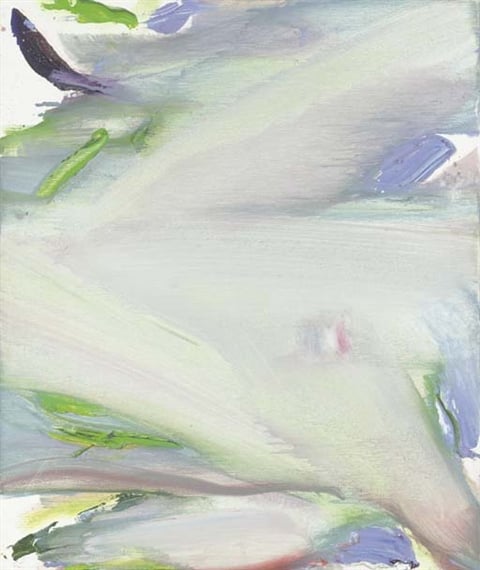
Printemps de tilleuls rose et bleu
Expert analysis of Olivier Debre’s Printemps de tilleuls rose et bleu
Style: Lyrical Abstraction · Genre: abstract
Artwork Analysis: Printemps de tilleuls rose et bleu by Olivier Debré
Style: Lyrical Abstraction | Genre: Abstract
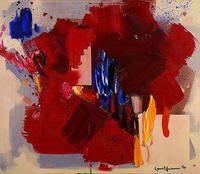
Olivier Debré’s Printemps de tilleuls rose et bleu (Spring of Pink and Blue Linden Trees) stands as a quintessential example of Lyrical Abstraction, a post-World War II movement that prioritized spontaneous, emotive expression over rigid geometric formalism. Within this context, the painting’s significance lies in how Debré synthesizes the movement’s core concerns—color, gesture, and atmospheric resonance—while grounding them in a subtle, poetic relationship with the natural world.
The title itself is revealing: it evokes the delicate, fleeting beauty of spring linden blossoms, yet Debré does not attempt to depict the trees literally. Instead, he translates their essence into sweeping fields of pink and blue, creating a luminous, immersive field of color. This approach aligns with Lyrical Abstraction’s rejection of figuration in favor of a “inner landscape” or emotional truth. Debré’s hallmark is his ability to make color feel both physical and ethereal; here, the interplay of rose and blue suggests warmth, renewal, and a soft atmospheric depth, as if the painting itself breathes with the season.
Debré was a leading figure in the French branch of Lyrical Abstraction, a movement that paralleled American Abstract Expressionism but retained a distinct sensitivity to light, space, and poetic ambiguity. In Printemps de tilleuls rose et bleu, the lack of hard edges or defined forms forces the viewer to engage with pure chromatic sensation and the artist’s gestural trace. The work’s significance is further underscored by Debré’s innovative use of large, unbroken color zones—what he called signes—which he saw as direct carriers of emotion. This piece exemplifies that principle: the pink and blue are not mere colors but conduits for a serene, almost meditative lyricism that defines the best of the movement.
In sum, Debré’s painting is significant for its masterful distillation of natural inspiration into a language of pure abstraction, where color and gesture alone evoke the transient beauty of spring. It is a testament to Lyrical Abstraction’s enduring power to marry feeling with form.
Genre
Style
Visually similar
20 works with related composition and palette
Ouarzazate
Olivier Debre
Untitled
Mary Abbott
Dibirdibi Country
Sally Gabori
Shangaï
Monique Orsini
Distant View
Friedel Dzubas
Linear Yam Dreaming
Emily Kame Kngwarreye
La grande fracture des matins
Jean Messagier
Untitled
Mostafa Dashti
Blue window
Eugene Brands
Reclining Man (John F. Kennedy)
Willem de Kooning
Woman - Red Hair, Large Mouth, Large Foot
Willem de Kooning
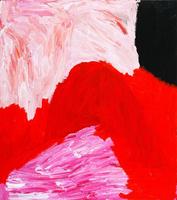
Dibirdibi Country
Sally Gabori
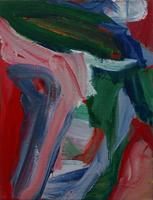
Forest Edge 1. - - abstract painting by Fons Heijnsbroek - Dutch artist
Fons Heijnsbroek
Composition
Jean Messagier
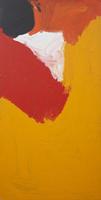
Dibirdibi Country
Sally Gabori
Cocoon
Dan Goorevitch
Untitled
Lucy Ivanova
Untitled
Joan Mitchell
Dibirdibi Country
Sally Gabori
The Clash
Hans Hofmann