
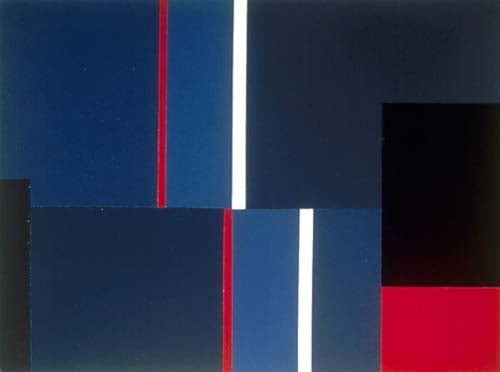
Nassos Daphnis sanatçısının Aegean Series 6-A-92 eseri hakkında uzman analizi
Tarz: Hard Edge Painting · Tür: abstract
Expert Analysis: "Aegean Series 6-A-92" by Nassos Daphnis
Nassos Daphnis (1914–2010) is a pivotal figure in the development of Hard Edge Painting, a movement that emerged in the late 1950s as a counterpoint to the gestural energy of Abstract Expressionism. Hard Edge Painting is characterized by clean, sharp contours, flat areas of unmodulated color, and a rigorous, impersonal execution that emphasizes the two-dimensionality of the canvas. Daphnis’s work—particularly his long-running "Aegean Series"—exemplifies these principles while infusing them with a personal, meditative geometry.
Significance within Hard Edge Painting
What makes Aegean Series 6-A-92 significant is its synthesis of geometric precision with a subtle, evocative spatial resonance. Daphnis, an early adopter of Hard Edge alongside artists like Ellsworth Kelly and Al Held, was unique for his use of repeated, interlocking forms—often bands, disks, or segmented arcs—that create a dynamic interplay between figure and ground. In this piece, the title “Aegean” connects his vocabulary to the light, sea, and architecture of his native Greece, yet the work remains resolutely abstract. The “6-A-92” likely denotes a specific configuration of shape and color within the series, underscoring Daphnis’s systematic, almost serial approach to composition.
The painting’s significance lies in its demonstration of how Hard Edge could achieve optical vibrancy without relying on painterly expressiveness. Daphnis’s forms—often derived from the circle and its fragmentation—push against the edges of the canvas, generating a tension that is both cool and dynamic. By reducing his palette to a few saturated hues and bounding them with razor-sharp curves, he invites the viewer to experience color as pure, self-sufficient presence. This approach bridges the late Abstract Expressionist interest in the sublime with the emerging Minimalist ethos of reduction, making Daphnis a crucial transitional figure.
Broader Artistic Context
Daphnis’s "Aegean Series" is also notable for its engagement with ancient and modern geometries: the forms echo Cycladic art, Byzantine iconography, and the digital logic of computer graphics (Daphnis later used a computer to plan his compositions). 6-A-92 thus stands as a testament to the artist’s lifelong exploration of how absolute, non-referential shapes can evoke a specific cultural memory—here, the remembered light and rhythm of the Greek archipelago—while remaining utterly contemporary in its precision.
In summary, this work is significant because it epitomizes the Hard Edge commitment to clarity, surface flatness, and rational order, yet it transcends mere formalism through its subtle reference to landscape and light. It is a masterful example of how geometric abstraction can be both rigorously intellectual and deeply sensual.
Görsel olarak benzer
İlişkili kompozisyon ve renk paletine sahip 20 eser
1 + 3 x 3
Camille Graeser
Untitled
Ivan Serpa
Three Yellows Vertical
Ilya Bolotowsky
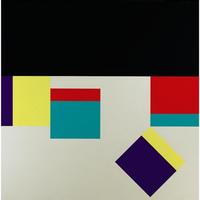
Elements in Movement
Camille Graeser
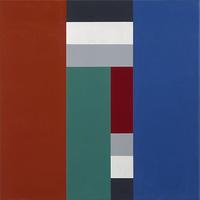
Rote Dominante
Camille Graeser

Untitled (9 - 1 - A - 17)
Yves Gaucher
Contra-Composition VII
Theo van Doesburg
Untitled
Antonio Palolo
Untitled
Rodolfo Arico
Star (for Patti Smith)
Brice Marden
Counter Composition IV
Theo van Doesburg
Q1
Jean-Francois Dubreuil
Q3
Jean-Francois Dubreuil
Composition XIII
Theo van Doesburg
4 x 4 Bewegungen um eine Achse
Richard Paul Lohse
Study II
Brice Marden
Untitled
Rubem Ludolf
Q2
Jean-Francois Dubreuil
Looking Glass
Gene Davis
Variation in Red Diamond
Ilya Bolotowsky