
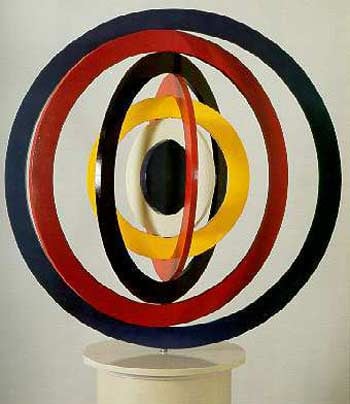
Expertenanalyse zu Nassos Daphniss Sphere 12-68
Stil: Op Art · Genre: sculpture
Expert Analysis of "Sphere 12-68" by Nassos Daphnis
Nassos Daphnis’s Sphere 12-68 (1968) is a quintessential example of Op Art translated into three dimensions, marking a significant intersection between hard-edge abstraction and perceptual experimentation. As a sculpture, it extends Op Art’s core mission—to engage the viewer’s visual system through precise, often disorienting patterns—into physical space, where movement and light become active participants.
The work’s surface is likely divided into a systematic grid of alternating, high-contrast colors or black-and-white geometric segments (typical of Daphnis’s practice), applied with immaculate precision. This pattern exploits retinal afterimages and moiré effects, causing the sphere to appear to pulse, bulge, or flatten as the viewer walks around it. The spherical form itself is critical: unlike a flat canvas, the curvature warps the pattern, creating a continuous, dynamic optical field that changes with every angle of view.
Significance within Op Art and its period:
- Pushing Op Art into sculpture: While most Op artists (e.g., Victor Vasarely, Bridget Riley) worked on flat surfaces, Daphnis adapted its optical principles to three-dimensional objects. Sphere 12-68 demonstrates that Op effects are not merely illusions on a plane but can be generated by real, volumetric forms interacting with ambient light and spectator motion.
- Hard-edge precision: Daphnis was a pioneer of hard-edge painting in the 1950s, and his sculpture retains that rigorous geometry. The flawless execution eliminates any trace of the artist’s hand, forcing the viewer to focus on pure visual sensation—a hallmark of Op Art’s scientific approach to perception.
- Engaging the body and space: Unlike static sculpture, this piece demands movement. The viewer must circle it to fully experience the shifting patterns, making active observation a condition of the work. This anticipates later kinetic and participatory art of the 1970s, while remaining firmly rooted in the perceptual obsessions of the late 1960s.
In context, Sphere 12-68 stands as a landmark of how Op Art could escape the picture plane, asserting that optical illusion is not just a trick of the eye but a physical, spatial experience. Daphnis’s sphere remains a powerful synthesis of form, color, and perception—a precise machine for visual astonishment.
Visuell ähnlich
20 Werke mit ähnlicher Komposition und Farbpalette
Multikinetic Wall
Wen-Ying Tsai
Object with Red Ball
Alexander Calder

Halos concéntricos
Kalato
Untitled (Sphére)
Gregorio Vardanega
Rzeźba Abstrakcyjna II
Katarzyna Kobro
Model for 'Rotating Fountain'
Naum Gabo

Rzeźba Abstrakcyjna I
Katarzyna Kobro
Yunus I
Katsuhito Nishikawa
Espiral del Viento I
Martin Chirino
A Universe
Alexander Calder
Head
Julio Gonzalez
Saturno
Lino Tagliapietra
Leda
Noguchi Isamu
Concave Shadow Sculpture
Burhan Dogancay
Untitled (from the series Transformable Structures)
Sandu Darie
Sky Hook (Maquette)
Louise Nevelson
Trajans Edge II
Al Held
Space Churn
George Rickey

Trepante
Lygia Clark
«Radiance»
Ludwiga Nesterovich