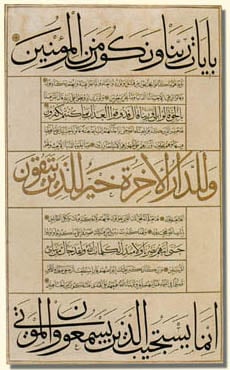
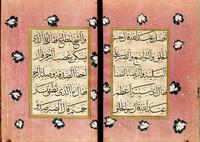
Sura Al-An'am written in Muhaqqaq, Thuluth and Naskh calligraphic styles
Analisi esperta di Sura Al-An'am written in Muhaqqaq, Thuluth and Naskh calligraphic styles di Ahmed Karahisari
Stile: Ottoman Period · Genere: calligraphy
Expert Analysis: "Sura Al-An'am written in Muhaqqaq, Thuluth and Naskh calligraphic styles" by Ahmed Karahisari
This work stands as a masterful synthesis of the three most revered scripts in Islamic calligraphy—Muhaqqaq, Thuluth, and Naskh—executed by one of the Ottoman period’s most virtuosic calligraphers, Ahmed Karahisari. Its significance lies in the rare and deliberate combination of these distinct styles within a single composition, each serving a unique visual and structural purpose.
Muhaqqaq, known for its majestic, elongated vertical strokes and sweeping curves, typically anchors the primary text or key phrases, lending monumental gravitas to the Sura. Thuluth, with its elegant, proportional ductus and dramatic interplay of thick and thin lines, often frames or highlights secondary elements, adding rhythmic movement. Naskh, the most legible and compact of the three, provides clarity and readability for dense passages of the Quranic chapter (Surah Al-An'am). By weaving them together, Karahisari demonstrates not only technical mastery of each script’s strict geometric rules but also an intuitive sense of harmony, turning the page into a layered, polyphonic visual experience.
Historically, Ahmed Karahisari (1469–1566) is revered as a reformer who revived the classic “Six Pens” (Aqlam al-Sitta) traditions in the Ottoman court, resisting the trend toward the simpler scripts favored by his contemporaries. This artwork epitomizes his ambition to elevate calligraphy beyond mere transcription into a transcendent art form, where the sacred text becomes a vehicle for aesthetic worship. The choice of Surah Al-An'am (“The Cattle”), a long Meccan surah emphasizing divine unity and revelation, further underscores the work’s devotional and intellectual depth.
In the context of Ottoman art, such a multi-script composition was exceptionally rare—most calligraphers specialized in one or two scripts. Karahisari’s ability to blend them seamlessly, without sacrificing the integrity of any style, marks this piece as a landmark of calligraphic innovation, showcasing the pinnacle of Ottoman craftsmanship and spiritual expression.
Visivamente simili
20 opere con composizione e palette affini
A large size mushaf
Ahmed Karahisari
Celi Sülüs
Mustafa Rakim
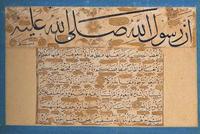
Hadith
Sheikh Hamdullah
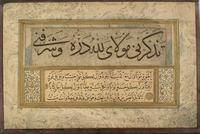
Untitled
Sheikh Hamdullah
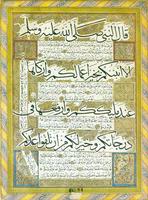
Levha - Hadis-i Şerîf
Sheikh Hamdullah
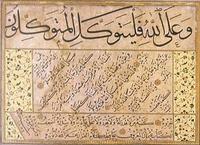
Untitled
Hafiz Osman
Kıta - Hadis-i Şerîfler
Mustafa Rakim
Levha
Mustafa Rakim
Hilye
Hafiz Osman
Kıta - Hadis-i Şerîf
Mustafa Rakim
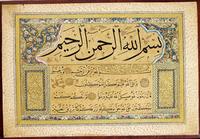
Murakka (calligraphic album)
Hafiz Osman
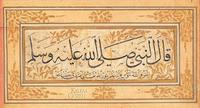
Kıta - Hadis-i Şerîf
Sheikh Hamdullah
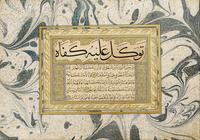
Untitled
Sheikh Hamdullah
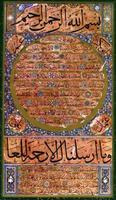
Hilye
Hafiz Osman
Untitled
Ahmed Karahisari
Untitled
Ahmed Karahisari
Untitled
Sheikh Hamdullah
Kıta
Sheikh Hamdullah
Prayer manual
Hafiz Osman
Muttasıl Müfredat
Mustafa Rakim