Hans von Aachen sanatçısının Bacchus, Ceres and Amor eseri hakkında uzman analizi
Tarz: Mannerism (Late Renaissance) · Tür: mythological painting
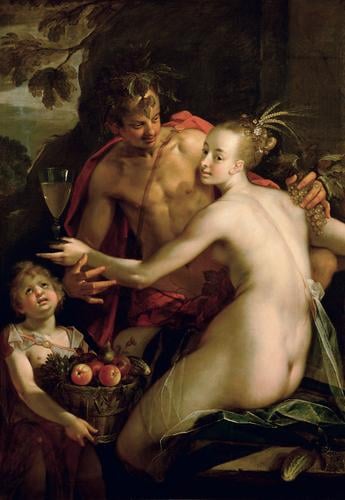
Expert Analysis: "Bacchus, Ceres and Amor" by Hans von Aachen
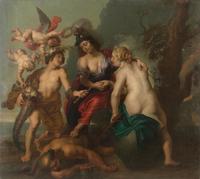
Hans von Aachen’s Bacchus, Ceres and Amor exemplifies the sophisticated artifice of Mannerism (Late Renaissance) through its deliberate distortion of classical ideals, intricate composition, and layered allegorical content. As a mythological painting, it draws on ancient deities not for naturalistic storytelling but for intellectual and sensual play—a hallmark of the refined courtly culture for which von Aachen worked.
Stylistic Significance
True to Mannerist principles, the figures are elongated and posed in serpentine, interlocking contrapposto that defies gravity. Bacchus, Ceres, and Amor are compressed into a shallow, almost claustrophoric space, their limbs weaving a decorative, S-curved silhouette. The palette is unnaturally bright and artificial—icy pinks, acid greens, and golden highlights—creating a porcelain-like surface that emphasizes artifice over naturalism. This departure from High Renaissance harmony underscores the period’s fascination with elegance, complexity, and the artist’s intellectual virtuosity.
Iconographic Play
The trio of Bacchus (wine), Ceres (grain/harvest), and Amor (love) forms a classic allegory for the cycle of pleasure and procreation: wine loosens desire, harvest sustains life, and love binds them. Von Aachen treats this with characteristic Mannerist ambiguity—the figures exchange knowing glances and tactile gestures (Amor’s arrow poised, Ceres’s drapery slipping) that blur the line between divine myth and erotic suggestion. This refined sensuality, devoid of vulgarity, appealed to the learned patrons of the Prague court, who prized hidden meanings and clever visual puns.
Historical Context
As a court painter to Emperor Rudolf II, von Aachen produced works that mirrored the emperor’s taste for erudite, enigmatic imagery. Bacchus, Ceres and Amor is significant as a prime example of Mannerism’s shift from religious devotion to intellectual and hedonistic subjects—a celebration of earthly pleasures filtered through a lens of calculated artificiality. Its compressed, anti-naturalistic space and intricate lines anticipate the decorative excesses of the Baroque while retaining the Mannerist obsession with formal complexity.
In sum, the painting is a masterclass in Mannerist sophistication: an artificial, self-aware tableau that transforms mythological allegory into a puzzle of line, color, and desire, marking a pivotal moment in late Renaissance art’s turn toward courtly aestheticism.
Museum / Gallery
Görsel olarak benzer
İlişkili kompozisyon ve renk paletine sahip 20 eser
Pan and Selene
Hans von Aachen
Venus, Cupid and a satyr
Hans von Aachen
Venus and Adonis
Theodoor van Thulden
An Allegory of Fortune
Dosso Dossi
Venus, Cupid, Bacchus and Ceres
Peter Paul Rubens
Venus with a Satyr and Cupids
Annibale Carracci
Salmacis et Hermaphrodite
Jean-François de Troy
Venus and Adonis
Peter Paul Rubens
Venus, Adonis, and Cupid
Annibale Carracci
Venus and Adonis
Bartholomeus Spranger
Education of Jupiter
Jacob Jordaens
Paris and Oenone
Jean-François de Troy
Venus in Vulcan's Forge
Bartholomeus Spranger
An Allegory of Love
Benvenuto Tisi
The Feast of Bacchus
Jan Brueghel the Younger
Diana Y Ninfas
Lorenzo Pasinelli
The Four Seasons
Cornelis de Vos
Hercules and Omphale
Francois Boucher
?
Theodor van Thulen
VENUS AND ADONIS; DIANA AND ENDYMION
Louis Cheron