
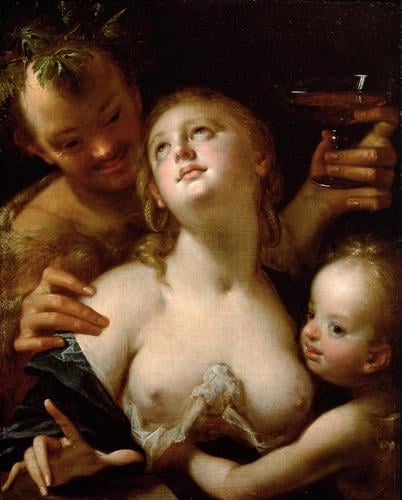
Analisi esperta di Bacchus, Venus and Cupid di Hans von Aachen
Stile: Mannerism (Late Renaissance) · Genere: mythological painting
Expert Analysis: "Bacchus, Venus and Cupid" by Hans von Aachen
Hans von Aachen’s Bacchus, Venus and Cupid is a quintessential example of Northern Mannerist painting, a style that flourished in the late 16th century at courts like that of Emperor Rudolf II in Prague, where von Aachen was a leading artist. The work’s significance lies in its masterful synthesis of Italianate Mannerist elegance with Northern European refinement, creating an intellectual and erotic allegory that embodies the period’s fascination with classical mythology and sophisticated sensuality.
Stylistic Hallmarks of Mannerism
The painting exhibits the defining traits of Mannerism: elongated, graceful figures arranged in complex, serpentine poses; a cool, artificial palette that heightens emotional distance; and a deliberate departure from High Renaissance naturalism. Von Aachen’s composition is densely packed, yet each figure is isolated in its own sinuous curve—Bacchus’s tilting head, Venus’s twisting torso, and Cupid’s dynamic gesture. This creates a rhythm of interlaced limbs and glances that draw the viewer’s eye in a restless, intellectual circuit rather than a naturalistic narrative. Such artifice was prized in Mannerist art as a display of the artist’s grazia (grace) and ingegno (wit).
Mythological and Erudite Allegory
The grouping of Bacchus (god of wine and ecstasy), Venus (goddess of love), and Cupid (desire) was a familiar Mannerist trope, but von Aachen infuses it with layered meaning. Bacchus often represents the irrational, instinctual forces of nature, while Venus embodies beauty and sensual love. Their interaction here—Venus receiving wine from Bacchus, Cupid drawing near—alludes to the classical topos that wine and love are inseparable, and that passion can be both inspired and intoxicated. The erotic tension is palpable but refined: nudity is demurely veiled by limbs and drapery, typical of courtly Mannerist decorum. This intellectualized eroticism, rather than overt carnality, was designed to delight and challenge the connoisseur’s mind.
Significance Within Its Period
The painting is significant for two reasons. First, it represents the cross-pollination of Italian Mannerism (especially the work of Parmigianino and Correggio) with the meticulous surface finish and luminous glazes of the Northern tradition. Von Aachen studied in Venice and Rome, but his handling of flesh and fabric retains a Northern precision. Second, the work reflects the cultural ambitions of the Rudolfine court: art as an instrument of esoteric knowledge, where classical mythology, alchemy, and Neoplatonic philosophy intertwined. Bacchus, Venus and Cupid is not merely a decorative myth but a visual riddle—an invitation to contemplate the union of love, intoxication, and divine ecstasy—that epitomizes the sophisticated, elite taste of Late Renaissance Central Europe.
Museum / Gallery
Visivamente simili
20 opere con composizione e palette affini
Pallas Athena, Venus and Juno
Hans von Aachen
Couple with a mirror
Hans von Aachen
Study of a Female Figure Facing Right (Penitent Magdalene)
Giulio Cesare Procaccini
Martyrdom of Saints Secunda and Rufina (detail)
Giulio Cesare Procaccini
An Allegory of Christian Charity
Luca Giordano

Venus, Cupid and a satyr
Hans von Aachen
Tarquin and Lucretia
Luca Giordano
Venus and Mercury Blindfold Cupid
Bartholomeus Spranger
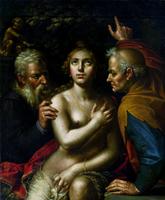
Susanna and the Elders
Hendrick Goltzius
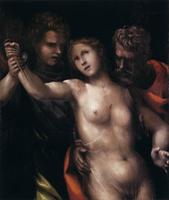
The Death of Lucretia
Il Sodoma
Scene
Onofrio Gabrieli
Sibila Budrioli
Lorenzo Pasinelli
Venus and Amor
Paolo Veronese
Death of Cleopatra
Guido Reni
Hope feeding love
Karl Bryullov

Portrait of Wigbold Slicher and Elisabeth Spiegel as Paris Handing Venus the Appel
Ferdinand Bol
The Toilet of Venus
Guercino

Virgin and Child with the Infant St. John
Peter Paul Rubens

The Mystic Marriage of St Catherine
Giulio Cesare Procaccini
Venus at her Toilet
Peter Paul Rubens