Analisi esperta di Mu! di Kasumi Bunsho
Stile: Zen · Genere: calligraphy
Expert Analysis of "Mu!" by Kasumi Bunsho
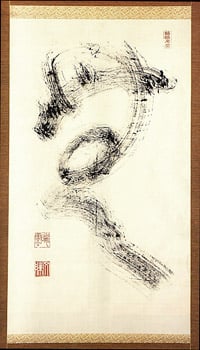
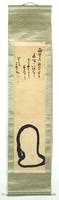
In the sparse, one-character calligraphy of Kasumi Bunsho titled "Mu!", we encounter a distilled expression of Zen’s most profound paradox. The character Mu (無)—meaning “no,” “nothing,” or “without”—is the koan’s silent thunder, famously the answer to the question, “Does a dog have Buddha-nature?” Here, Bunsho does not merely write a word; he enacts the state of emptiness through the very gesture of the brush.
Significance within Zen Calligraphy
-
The Power of the Single Character: In Zen tradition, a single ideograph can be a complete teaching. Bunsho’s “Mu!” strips away all narrative, leaving only the essential. The exclamation point in the title (not written in the original ink, but implied in the title’s punctuation) suggests a sudden, explosive release—the moment of kenshō (seeing one’s true nature) when the mind abandons dualistic thought. The brushwork itself likely shows a rapid, untamed stroke—thick at the stem, dry and flying off at the tail—embodying the artist’s direct, unmediated energy.
-
Gestural Spontaneity vs. Emptiness: Unlike decorative calligraphy, Zen shodō values shin (heart-mind) over perfection. The character Mu is particularly challenging because it contains a dense web of horizontal and vertical lines, yet Bunsho’s version leaves generous white space—the ma (interval) that is not blankness but pregnant potential. The negative space around the character is as meaningful as the ink: it is the “nothing” that contains all things. In this, the work becomes a visual koan—the viewer is invited to see Mu not as a letter but as a direct pointer to what cannot be grasped.
-
Zen’s Antithesis to Artistic Ego: Many calligraphers seek to display skill or beauty. Bunsho’s “Mu!” rejects ornament. The brushwork likely appears nearly violent in its simplicity—perhaps a single, unretouched stroke that starts wet and ends dry, showing the artist’s breath and bodily rhythm. This is not a symbol to be read, but an event to be experienced. The exclamation in the title reinforces the idea of a sudden awakening: the ink is the shout, the paper is the silence after.
In the broader history of Zen art, “Mu!” by Kasumi Bunsho stands as a radical gesture. It condenses centuries of philosophical inquiry into a single, present-moment action—reminding us that the most profound truths are not found in words, but in the empty space where words dissolve.
Visivamente simili
20 opere con composizione e palette affini
Dragon Call
Kasumi Bunsho
Heart
Kasumi Bunsho
Single Line Calligraphy
Nakahara Nantenbo

Dragon Calligraphy
Deiryu
Calligraphy
Enji Torei
Dragon Calligraphy
Kasumi Bunsho
Sword
Kasumi Bunsho
寿 置き字
Zenkei Shibayama
Cranes, Hares
Kasumi Bunsho
Hisashi
Yamamoto Gempo
Hakuin
Enji Torei
Single Line Calligraphy
Deiryu
Daruma from Behind
Nakahara Nantenbo
Sun - Moon
Nakagawa Soen
Calligraphy
Yamamoto Gempo
Dragon Enso
Kasumi Bunsho
In a single stroke
Alfred Freddy Krupa
寶置字
Zenkei Shibayama
Calligraphy, Dai-setsu
Soen Kogaku
Wall Gazing Daruma
Nakahara Nantenbo