Análisis experto de Desert Landscape de John Ferren
Estilo: Abstract Expressionism · Género: abstract
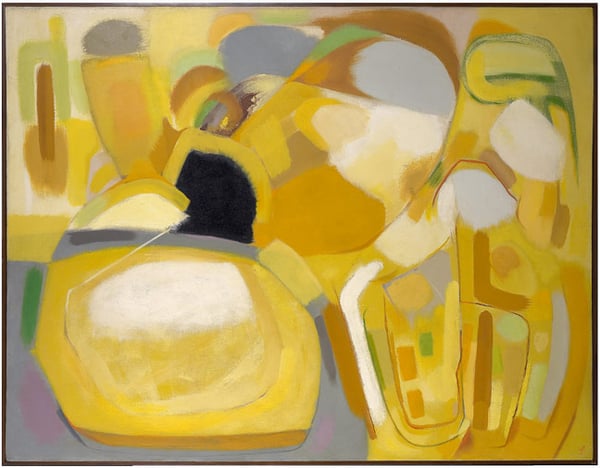
"Desert Landscape" by John Ferren (1923–2001) is an exemplary work of Abstract Expressionism that demonstrates the artist's distinctive synthesis of European modernist influences with the gestural dynamism of the New York School. While the painting is fully abstract, its title invites the viewer to perceive the desert through a vocabulary of sweeping brushstrokes, layered color fields, and organic forms—a hallmark of Ferren's mature style.
Significance within Abstract Expressionism:
-
Bridging European and American abstraction: Ferren spent formative years in Paris (1930s–early 1940s), absorbing Surrealist automatism and cubist structure. "Desert Landscape" reflects this hybridity: the composition balances improvisational, almost calligraphic marks (akin to Franz Kline) with a warm, earthy palette that evokes the American Southwest, a region Ferren later explored. This duality marks him as a transatlantic conduit in the movement.
-
Landscape as a point of departure: Unlike pure non-objective painters, Ferren often retained subtle landscape referents. Here, the "desert" is suggested through sweeping horizontal bands of ochre, sienna, and muted blue—reminiscent of vast terrain and sky—overlaid with vigorous black or dark strokes that could signify wind, shadow, or rock fissures. This tension between representation and gesture was central to the Abstract Expressionist pursuit of the "sublime" in nature.
-
Color and materiality: Ferren's brushwork ranges from thin washes to thick impasto, creating a tactile surface that records the artist's physical engagement. The painting’s luminosity and atmospheric depth derive from layered translucent colors, a technique he refined after working with stained canvas (prefiguring Color Field painting). This handling aligns him with the more lyrical wing of Abstract Expressionism, alongside artists like Philip Guston or Robert Motherwell.
-
Legacy: Though less canonized than Pollock or de Kooning, Ferren's work—and "Desert Landscape" in particular—illustrates the diversity within Abstract Expressionism. It shows how the movement accommodated both explosive energy and contemplative, biomorphic abstraction, rooted in direct sensory experience of place. The painting is significant as a document of American art's shift from European-inspired figuration toward a distinctly national, gestural identity—while still honoring the natural world as a source of spiritual and formal inspiration.
Género
Estilo
Visualmente similares
20 obras con composición y paleta relacionadas
Sirocco
Judith Godwin
Months and Moons
Grace Hartigan
Untitled
Albert Bitran
Armageddon
Artin Demirci
Untitled
Richard Diebenkorn
Dibirdibi Country – Topway
Sally Gabori
Mondo e uomo
Antonio Sanfilippo
Untitled 14
John Altoon
Untitled
Albert Bitran
Sans titre (Paris, rue Gît-le-Coeur)
Bram van Velde
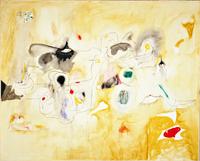
The Plough and the Song
Arshile Gorky
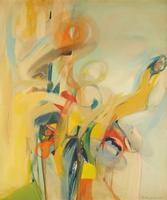
Down to Earth
Miriam Schapiro
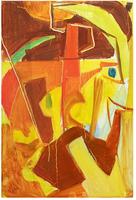
Untitled
Valerii Lamakh
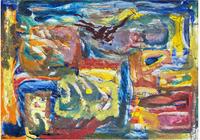
Composition
Valerii Lamakh
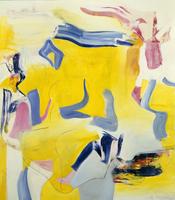
Untitled III
Willem de Kooning
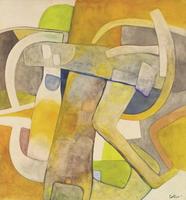
Composition 1062
Maurice Esteve
Composition 1062
Maurice Esteve
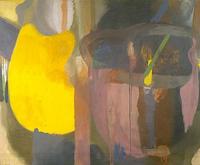
A Timeless Moment
Perle Fine
Imaginative Composition - 'The Tent'
David Bomberg
RELACIÓN DE FORMAS
Fernando García Ponce