Analisi esperta di One World di John Ferren
Stile: Abstract Expressionism · Genere: abstract
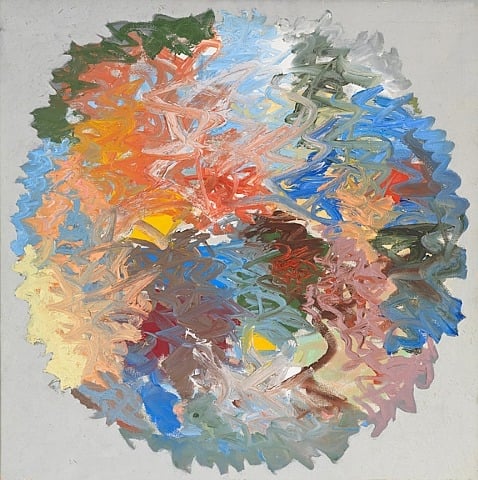
Expert Analysis of "One World" by John Ferren
John Ferren’s One World stands as a significant example of Abstract Expressionism, a style that emerged in mid-20th-century America emphasizing spontaneous, gestural, and non-representational expression. As an abstract work, it reflects the movement’s core rejection of figurative imagery in favor of pure form, color, and emotion.
Significance within Abstract Expressionism and Ferren’s Career
Ferren was a pivotal, though sometimes overlooked, figure in the New York School. He was among the first American artists to study in Paris with modernists like Fernand Léger and Stanley William Hayter, bringing a sophisticated European understanding of abstraction back to the United States. One World likely embodies this transatlantic synthesis, combining the biomorphic surrealism of Arp or Miró with the energetic, all-over composition characteristic of American Abstract Expressionism.
The title itself is historically telling. Created in the aftermath of World War II, “One World” evokes the era’s idealistic longing for global unity and peace—a theme that Ferren frequently explored. Within the context of Abstract Expressionism, the work’s significance lies in how it channels this universalist ambition through purely abstract means. Instead of depicting recognizable symbols, Ferren uses sweeping lines, layered fields of color, and dynamic, organic shapes to generate a sense of harmony and movement. This aligns with the movement’s belief that abstract canvases could convey profound emotional and philosophical truths without resorting to narrative or representation.
What Makes the Work Notable
One World exemplifies how Abstract Expressionists shifted from controlled composition to a more open, improvisational field. Ferren’s brushwork here likely balances disciplined structure with spontaneous gesture, a hallmark of his mature style. The painting’s significance is also in its bridging of European surrealist influences (such as automatic drawing) with the American emphasis on scale and physicality. For scholars, One World is a key piece demonstrating that Abstraction Expressionism was not monolithic—Ferren brought a distinctive lyrical, often more optimistic note to the movement, standing alongside but distinct from the more aggressive energies of Pollock or de Kooning.
In summary, One World is significant because it captures the idealistic, globalist spirit of its time through a sophisticated abstract language, and because it exemplifies John Ferren’s unique contribution to Abstract Expressionism as a bridge between European modernism and American postwar abstraction.
Genere
Visivamente simili
20 opere con composizione e palette affini
My Country
Sally Gabori
Tondo
Joan Mitchell
Untitled
Mary Abbott
Untitled
Manoucher Yektai
Sunflowers
Joan Mitchell
Waterfall
Endre Bartos
Untitled
James Brooks
Woman - Red Hair, Large Mouth, Large Foot
Willem de Kooning
Untitled
Joan Mitchell
Kaibun
Kazuo Shiraga
Untitled
Edward Avedisian
Untitled
Joan Mitchell
The Clash
Hans Hofmann
Miss T
Edward Avedisian
Neigeoliale
Marcel Barbeau
Wild Autumn
Louis Van Lint
Shangaï
Monique Orsini
Dance of the Two-Headed Dragon
Kazuo Shiraga
Composition with Black Stain
Alexander Bogen
Mistral de partout
Francois Arnal