Analisi esperta di Rock Totems di John Ferren
Stile: Abstract Expressionism · Genere: abstract
Artwork: Rock Totems (c. 1950s)
Artist: John Ferren
Style: Abstract Expressionism / Post-War American Abstraction
Genre: Abstract
Expert Analysis
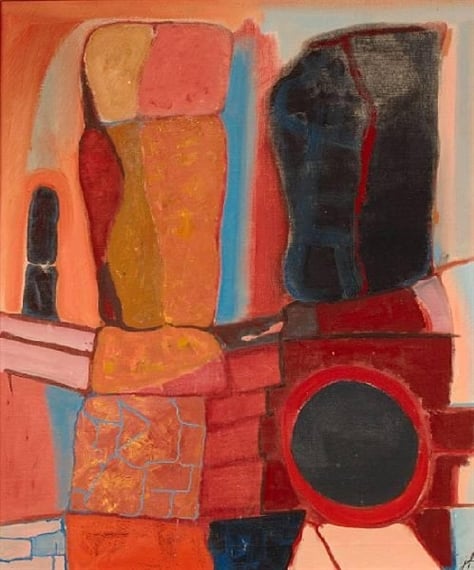
John Ferren’s Rock Totems stands as a compelling, if lesser-cited, example of Abstract Expressionism’s fascination with primal, archetypal imagery. While the movement is often dominated by the grand gestures of Pollock or the color fields of Rothko, Ferren represents a vital cross-pollination between European Surrealism and American gestural abstraction—he was among the few American artists who lived and worked in Paris in the 1930s, absorbing the lessons of Miró, Léger, and the Surrealists, before returning to New York to join the nascent New York School.
What makes Rock Totems significant within Abstract Expressionism is its deliberate fusion of biomorphic form with totemic structure. The painting’s title alludes to ancient, monolithic standing stones—primitive markers of ritual and myth—but Ferren translates those hard, vertical masses into floating, organically contoured shapes rendered with a rich, earthy palette. This tension between the sculptural gravity of a totem and the fluid, painterly handling of its surface is central to the work’s power.
Ferren avoids the all-over chaos of action painting; instead, he builds a composition around distinct, totemic entities that seem to both anchor the canvas and hover in an indeterminate space. The “rock” forms are heavy yet buoyant, their edges soft and bleeding—a hallmark of Ferren’s technique, where layered washes and impasto strokes create a sense of weathered antiquity. The underlying structure recalls the mythic abstraction of Adolph Gottlieb’s pictographs and the central verticals of Barnett Newman, yet Ferren’s touch retains a more tactile, sculptural quality, more attuned to the literal “rockness” of the forms.
As a work of Abstract Expressionism, Rock Totems exemplifies the movement’s ambition to evoke universal, pre-rational experience through purely abstract means. Ferren’s contribution to this ambition lies in his ability to marry European modernist composition (the careful placement of forms, the influence of Surrealist automatism) with a distinctly American sense of scale and materiality. The painting is significant not only for its successful synthesis of these traditions but also for its quiet, meditative presence—a reminder that Abstract Expressionism was not solely about explosive gesture, but also about the contemplation of enduring, almost ritualistic forms.
Genere
Visivamente simili
20 opere con composizione e palette affini
Eastern
James Brooks
Loxos
Maurice Esteve
Loxos
Maurice Esteve
Vigorou
Maurice Esteve
VIGOUROU
Maurice Esteve
Noirbel
Maurice Esteve
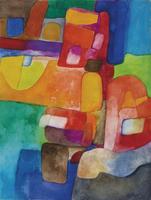
Composition
Maurice Esteve
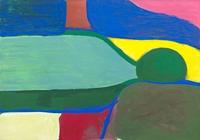
Figure sleeping
Harriet Korman
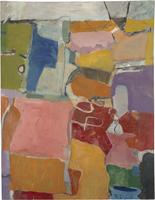
Urbana
Richard Diebenkorn
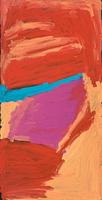
Dibirdibi Country
Sally Gabori
Bouleru
Maurice Esteve
Strolling
Will Barnet
Untitled
Maurice Esteve
Untitled
Maurice Esteve
Cin-Zin
Karl Knaths
Untitled Landscape
Henry Villierme
L’intérieur D’une Maison
Jacqueline Lamba
Chicago (detail)
Jean Rene Bazaine
Rot-vertikal
Fritz Winter
Beurdinu
Maurice Esteve