Mythologie des Arcanes
Analisi esperta di Mythologie des Arcanes di Victor Brauner
Stile: Surrealism · Genere: symbolic painting
Expert Analysis: "Mythologie des Arcanes" by Victor Brauner
Significance within Surrealism and Symbolic Painting
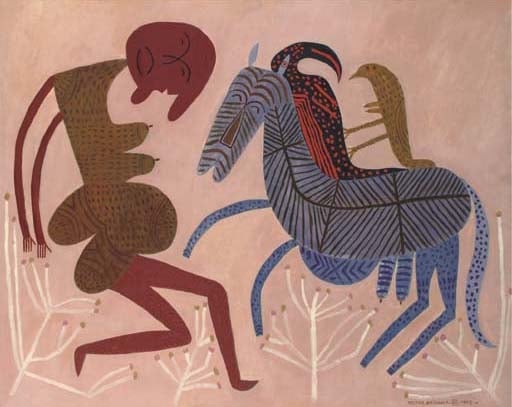
Victor Brauner’s Mythologie des Arcanes stands as a pivotal work within Surrealist practice, merging the movement’s obsession with the unconscious mind with a deeply personal, esoteric symbolism. Painted during the late 1930s or early 1940s—a period when Brauner was increasingly fascinated by alchemy, tarot, and occult traditions—this piece exemplifies Surrealism’s turn toward myth-making as a way to navigate psychological and historical turbulence.
Stylistic and Symbolic Uniqueness
The title itself, Mythologie des Arcanes (“Mythology of the Arcana”), directly references the tarot’s major arcana cards, which Brauner treated not merely as divinatory tools but as archetypal keys to the collective unconscious. In this work, he assembles a personal pantheon of hybrid creatures, floating biomorphic forms, and hieratic figures that seem to emerge from a dream space where ancient myth and modern anxiety collide. The composition is deliberately ambiguous: animals, humanoid shapes, and abstract symbols intermingle on a shallow, indeterminate ground, evoking the liminal state between waking and dreaming—a central Surrealist concern.
What Makes It Significant
-
Integration of Occult and Automatism – While many Surrealists (e.g., André Breton) embraced automatic drawing to bypass rational control, Brauner infused his automatism with structured occult references. Mythologie des Arcanes demonstrates how he channeled spontaneous imagery into a coherent symbolic system, anticipating later interest in “mythological” surrealism.
-
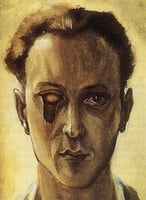
Personal Iconography as Universal Language – Brauner’s recurrent motifs—the eye (often wounded or multiplied), the egg, the wheel, the androgynous figure—appear here in dense interplay. The work is not just a picture but a visual riddle that invites viewers to decode their own unconscious responses, aligning with the Surrealist goal of transforming the spectator into an active participant.
-
Context of Exile and Foreboding – Brauner painted this during a period of personal and political crisis (he fled Europe for the South of France during WWII). The work’s tense, suspended atmosphere—figures seeming both trapped and generative—reflects the Surrealist preoccupation with the “marvelous” as a response to historical catastrophe.
Conclusion
Mythologie des Arcanes is significant because it pushes Surrealism beyond mere dream recording into a deliberate, mythopoetic realm. Brauner synthesizes occult tradition with radical artistic freedom, creating a visual language that feels both ancient and unsettlingly modern. For scholars, it marks a key moment when Surrealist painting turned inward to construct private mythos while still speaking to universal psychic structures—a balancing act that defines the movement’s most profound achievements.
Visivamente simili
20 opere con composizione e palette affini
Indigo Sky Mares
Laurel Burch
The album "Circus"
Fernand Leger
Flying Angels
Walter Battiss
Traber Team
Ernst Ludwig Kirchner
The Beauty and the Beast
Leopold Survage
Nocturne
Constantin Piliuta
The House of Animals
Corneille
The Birth of the Horse
Franz Marc
The rape of Bigarschol
David Bowie
La Fiancée de Kiriwina
Wifredo Lam
Man with Watering Can
Russ Warren
Maenads 2
Sorin Ilfoveanu
Satan
Wifredo Lam
San Miguel Arcangel
Sergio Hernández
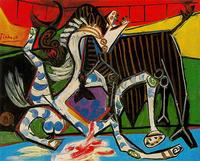
Bullfight
Pablo Picasso
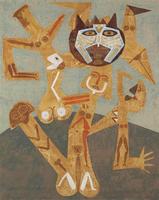
Arbre de la volupté
Victor Brauner
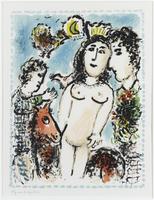
Coronated nude
Marc Chagall
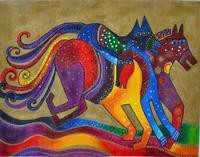
Dancing Horses
Laurel Burch
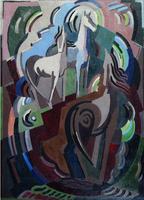
Achill Horses, 1934
Mainie Jellette
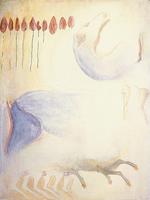
Renvers
Jo Baer