Analisi esperta di Mystery Card - My Visions di Howard Finster
Stile: Art Brut · Genere: figurative
Artwork Analysis: "Mystery Card – My Visions" by Howard Finster
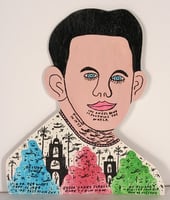
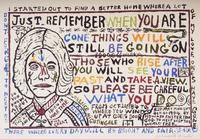
In Howard Finster’s Mystery Card – My Visions, the viewer encounters a quintessential work of Art Brut that exemplifies the raw, visionary impulse at the heart of outsider art. Finster, a self-taught preacher and artist, channeled his religious fervor and personal revelations into densely packed, figurative compositions that reject formal artistic training in favor of spontaneous, often ecstatic expression.
Significance within Art Brut and Finster’s Oeuvre:
-
Visionary Content as Core Motive – The title itself, My Visions, announces Finster’s primary creative engine: direct, personal revelation. Unlike mainstream art, which often prioritizes aesthetic innovation or conceptual rigor, Finster’s work is a direct transcription of spiritual experiences. This aligns perfectly with Art Brut’s emphasis on art born from inner necessity, untouched by institutional conventions.
-
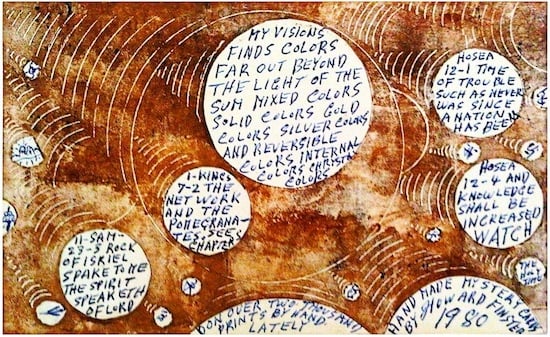
Figurative Density and Symbolic Layering – Although classified as figurative, Finster’s figures rarely exist in isolation. He crowds the picture plane with multiple heads, hands, and visionary symbols—often accompanied by hand-lettered text, numbers, and biblical references. This creates a compulsive, all-over visual field that mirrors the intensity of a prophetic trance. Careful observers will note that each element, no matter how small, is deliberately placed to convey a spiritual message.
-
Role of the “Mystery Card” Format – Finster frequently produced small, card-like works that he called “mystery cards.” These served as portable talismans or mini-altars, blending art, prophecy, and folk ritual. The format itself is significant: it democratizes the sacred, turning a humble card into a vessel for divine communication. This bridges his background as a Baptist preacher (handing out gospel tracts) with his identity as an artist.
-
Untrained Mark-Making and Authenticity – Finster’s linework is blunt, his colors often applied straight from the tube, and his scale shifts abruptly—all hallmarks of Art Brut. There is no attempt at illusionistic depth or refined modeling. Instead, the work pulses with the energy of a visionary who must get the image down before the vision fades. This raw, unpolished quality gives Mystery Card – My Visions its arresting sincerity and distinguishes it from academically composed figurative painting.
-
Place in Finster’s Larger Mission – Finster saw his art as a continuation of his ministry; he once claimed God told him to “paint sacred art.” Each work, including this one, is a fragment of his lifelong project to visually illustrate the Bible, prophecy, and his own encounters with angels and celestial beings. My Visions is thus not just a picture but a proclamation—a direct window into the artist’s soul and his urgent need to share a transcendent message.
Conclusion:
Mystery Card – My Visions is significant because it crystalizes the essential qualities of Art Brut in the American South: an untrained hand, a visionary worldview, and a compulsion to create that overrides any concern for market or technique. Howard Finster’s work remains a powerful testament to how figuration, when driven by inner vision rather than external rules, can achieve a profound, unsettling, and deeply human expressiveness.
Visivamente simili
20 opere con composizione e palette affini
Am Am Not Am Not Willing
Carl Andre
Untitled
Alevtyna Kakhidze
Guerilla Conditions
Brion Gysin
50 cent Piece
Jean-Michel Basquiat
Projet de frontispice pour Macbeth
Luc-Olivier Merson
Eroica II
Jean-Michel Basquiat
Suppose it is true after all? WHAT THEN?
John Baldessari
Old
Mel Bochner
Untitled (Plaid)
Jean-Michel Basquiat
Facing
Elsa von Freytag-Loringhoven
Fifty Days at Iliam. Shades of Eternal Night
Cy Twombly
Untitled
Alevtyna Kakhidze
Sublimation
Louise Bourgeois
Sublimation
Louise Bourgeois
Untitled
Alevtyna Kakhidze
Nobody Wants to See
Mladen Stilinovic
Florence Nightingale
Howard Finster
Untitled
Alevtyna Kakhidze
There is Only One Man in the World
Corita Kent
Under the Volcano
Pierre Alechinsky