
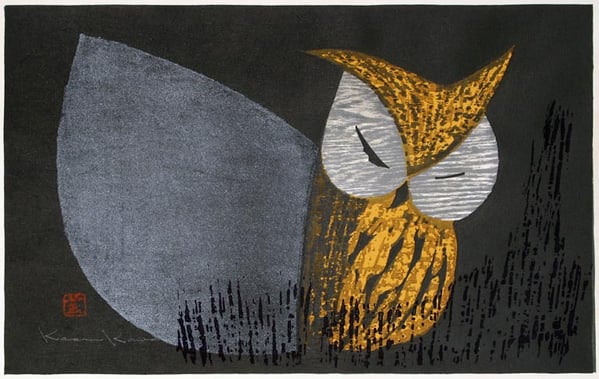
Expert analysis of Kaoru Kawano’s Owl
Style: Sōsaku hanga · Genre: animal painting
Expert Art Historical Analysis:
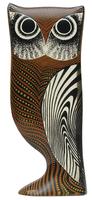
"Owl" by Kaoru Kawano (Sōsaku Hanga, Animal Painting)
This print stands as a compelling example of the Sōsaku hanga (creative print) movement, which revolutionized Japanese printmaking in the 20th century by insisting that the artist personally carve, ink, and print their own work—rejecting the traditional division of labor in ukiyo‑e. Kaoru Kawano (1916–1965) was a key postwar figure in this movement, and his "Owl" epitomizes the movement’s core values of individual expression, tactile materiality, and a modernized visual language.
Significance within Sōsaku Hanga:
Unlike earlier ukiyo‑e, where designers, carvers, and printers collaborated, Sōsaku hanga artists like Kawano controlled every step, making each print a unique, autographic statement. In "Owl," this personal touch is evident in the soft, hand‑carved linework and the varied texture of the inked surfaces—the feathers appear almost downy, achieved through careful woodgrain manipulation and multiple layered impressions. The print’s intimacy and quiet stillness reflect the movement’s shift from theatrical, narrative prints to a more introspective, modernist sensibility.
Stylistic and Symbolic Reading:
Kawano’s owls are among his most iconic subjects, and this example demonstrates his signature balance of Japanese aesthetic restraint and Western graphic simplicity. The owl’s large, luminous eyes engage the viewer with a direct, almost confrontational gaze, while its compact, rounded form is rendered in subtle, earthy gradations of brown and gray. The artist employs delicate bokashi (gradation) to model volume without heavy outlines, giving the bird a soft, living presence. In Japanese culture, the owl (fukurō) is a symbol of good luck and protection from hardship—a fitting emblem for postwar Japan—and Kawano elevates this folk motif to a refined work of fine art.
What Makes This Work Significant:
- Exemplar of the Sōsaku hanga ethos: It demonstrates the fusion of artist‑control, modernist reduction, and traditional woodblock technique.
- Kawano’s technical mastery: His fluid carving and sensitive color‑registering create a tactile, atmospheric quality that transcends mere representation.
- Iconic within the genre: Kawano’s owls are widely recognized as masterpieces of 20th‑century Japanese printmaking, bridging folk symbolism and contemporary fine‑art practice.
"Owl" is thus not just a charming animal portrait; it is a manifesto of the Sōsaku hanga movement’s core belief that the artist’s hand is the ultimate source of artistic authenticity.
Visually similar
20 works with related composition and palette
Three Eyes
Kaoru Kawano
The Big Owl
Kaoru Kawano
A Bird
Huang Yongyu
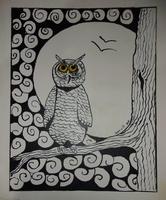
El búho y la luna
Martin Pereira
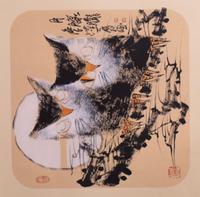
Hazy moon
Dayou Lu
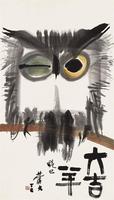
Owl
Huang Yongyu
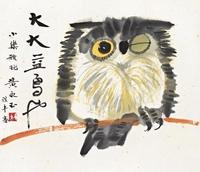
An Owl
Huang Yongyu
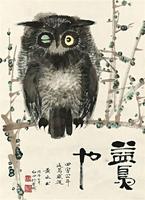
Owl
Huang Yongyu
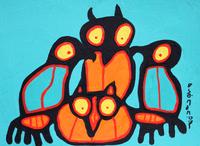
Two Owls and Two Chicks
Norval Morrisseau
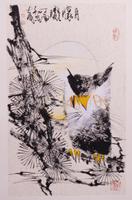
Hazy moon
Dayou Lu
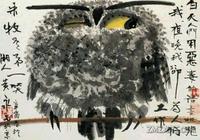
Owl
Huang Yongyu
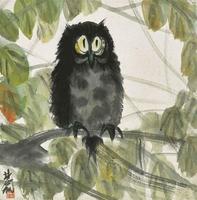
Owl
Lin Fengmian
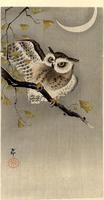
Owl on ginkgo branch (Scops owl under crescent moon)
Ohara Koson
Untitled (Grand Owl Habitat)
Joseph Cornell
Owls
Rudolf Láng
Untitled
Louis Wain
Hibou
Leon Spilliaert
Untitled (Owl)
Georges Ribemont-Dessaignes
Hazy moon
Dayou Lu
Owl
Abraham Palatnik