
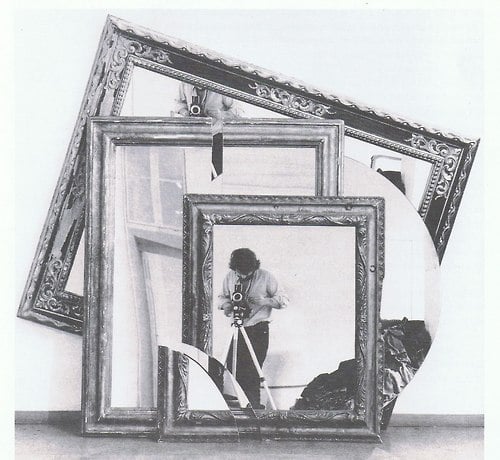
Expert analysis of Michelangelo Pistoletto’s The Form of the Mirror
Style: Conceptual Art · Genre: installation
Expert Analysis: "The Form of the Mirror" by Michelangelo Pistoletto
Within the framework of Conceptual Art and installation, Michelangelo Pistoletto’s The Form of the Mirror stands as a seminal work that redefines the relationship between the artwork, the viewer, and the space of art itself. Pistoletto, a leading figure of the Italian Arte Povera movement, here deploys the mirror as both material and concept—turning the traditional passive surface into an active, ever-changing element of the installation.
Significance within Conceptual Art
The work epitomizes Conceptual Art’s shift from object to idea. By using a mirror—a reflective surface that captures the immediate environment—Pistoletto eliminates the fixed image. Instead, the “form” of the mirror is not its physical shape but the infinite, contingent reflections it generates: the gallery architecture, the moving viewers, the shifting light. This aligns with Conceptual Art’s interest in dematerialization and the ephemeral. The artwork exists only in the moment of encounter, making each viewing unique.
Genre-defying Installation
As an installation, The Form of the Mirror dissolves boundaries between art and life. The viewer is not an observer but a participant whose reflection becomes part of the composition. Pistoletto deliberately blurs the line between representation and reality—the mirror “mirrors” not a painted scene but the actual world, including the viewer’s own body. This challenges traditional genres (painting, sculpture) and asserts that meaning arises from the context and interaction rather than from a static object.
Key Contribution
Crucially, The Form of the Mirror prefigures late 20th-century concerns with audience participation and site-specificity. It questions authorship: Who creates the spectacle—the artist (by placing the mirror) or the viewer (by appearing in it)? Pistoletto’s installation thus becomes a philosophical tool, asking us to consider art as a dynamic, relational field rather than as an autonomous object. This radical reframing cements its importance in the history of Conceptual Art and installation practice.
Visually similar
20 works with related composition and palette
Sombra projectada de Andre Morain
Lourdes Castro
Cast Shadow of André Morain
Lourdes Castro
Andy Warhol
Andrey Allakhverdov
Magic Lanterns
Conroy Maddox
Installation View
Claude Rutault
Installation View
Claude Rutault
Highland Park, IL (Self-Portrait, Bedroom Mirror)
Vivian Maier
White Painting #614
Christian Eckart
Untitled (025)
Rafa Nasiri
Cabinet d’Amateur #1
Pedro Cabrita Reis
White Painting #619
Christian Eckart
Lisbon Gates
Pedro Cabrita Reis
The Photagrapher Sescau
Henri de Toulouse-Lautrec
Guilded Frame
Jan Maarten Voskuil
Three Figures, One with Shotgun
Francis Bacon
Gross Arnold, Műteremben.
Gross Arnold
Flea Market Vendor
Duane Hanson
4 Series of 67
Antonio Areal
Artist's studio on street La Boetie
Pablo Picasso

The conquest
Hanno Karlhuber