Expertenanalyse zu Bela Czobels Still-life in Yellow
Stil: Fauvism · Genre: still life
Expert Analysis: "Still-life in Yellow" by Bela Czobel (Fauvism)
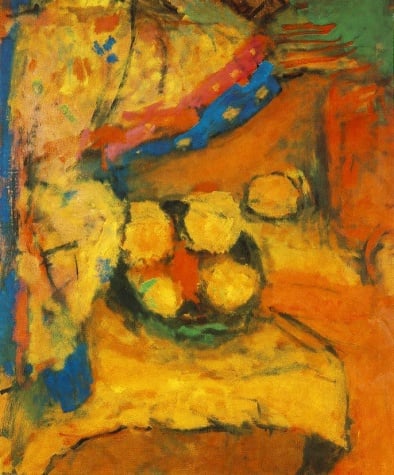
Bela Czobel’s Still-life in Yellow exemplifies the radical color experimentation at the heart of Fauvism, a movement that liberated painting from naturalistic representation. Although we have only the title, style, and genre, the work’s significance becomes clear when placed within the Fauvist canon.
Color as Structure and Emotion
The title itself signals the painting’s central innovation: a relentless focus on a single hue. In Fauvist fashion, Czobel does not use yellow merely to describe objects (e.g., lemons or a tablecloth) but to construct an entire pictorial atmosphere. Color takes precedence over local truth, transforming a humble still life into a vibrating, almost abstract field of energy. This chromatic intensity was revolutionary—it rejected the muted tonalities of Impressionism and embraced pure, unmixed pigments applied with visible, expressive brushwork.
Hungarian Fauvism: A Distinctive Voice
Czobel was a key member of “The Eight” (Nyolcak), a Hungarian avant-garde group that synthesized French Fauvism with local heritage. While Matisse and Derain derived their palette from Mediterranean light, Czobel’s Still-life in Yellow may carry a sharper, more melancholic resonance—a Central European reinterpretation. The work’s significance lies in how it adapts Fauvist freedom to a different cultural and emotional register, proving that the movement was not a monolithic French style but a flexible, transnational language of modern expression.
Structure over Chaos
Despite its explosive color, a Fauvist still life retains structural discipline. Czobel likely uses yellow’s varying temperatures (lemon, ochre, gold) to create depth and volume without relying on traditional chiaroscuro. The composition probably flattens space, pushing objects toward the picture plane—a hallmark of Fauvism’s move toward modernist abstraction. In this, Still-life in Yellow stands as a bridge between 19th-century realism and the purely color-driven works of later Expressionists and abstract painters.
Significance
This painting matters because it demonstrates Fauvism’s core ambition: to make color the primary vehicle of feeling and form. By focusing almost obsessively on yellow, Czobel challenges viewers to see a still life not as an imitation of things, but as an emotional and visual event. It is a testament to how a seemingly limited palette can achieve extraordinary expressive power—one of the key lessons Fauvism bequeathed to modern art.
Visuell ähnlich
20 Werke mit ähnlicher Komposition und Farbpalette
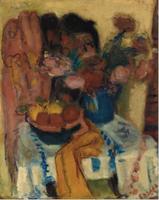
Bela Adalbert Czobel , Still Life on a Table
Bela Czobel
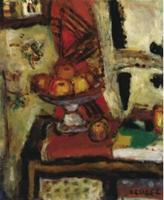
Bela Czobel Still Life with Fruit Dish
Bela Czobel
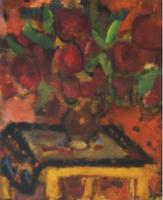
Bela Czobel Still Flover Interior
Bela Czobel
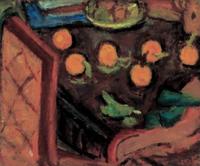
Still-life with Oranges
Bela Czobel
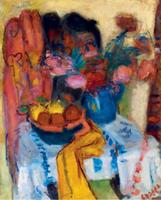
Czóbel Béla, Műtermi Csendélet Gyümölcsökkel
Bela Czobel
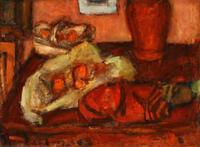
Czóbel Béla Csendélet 1935, Olaj, Vászon, 60x80cm
Bela Czobel
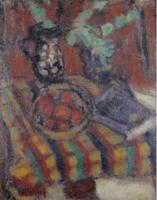
Czóbel Béla, Csendélet Gyümölcsel
Bela Czobel
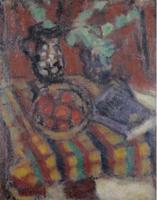
Czóbel Béla, Csendélet Gyümölcsel
Bela Czobel
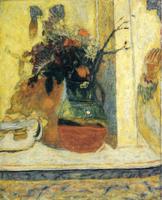
Pitcher
Pierre Bonnard
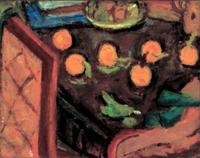
Bela Czobe Still Life with Orange
Bela Czobel
Czóbel Beéa 1930
Bela Czobel
Bela Czobel, Nature Morte
Bela Czobel
Female Nude
Bela Czobel
Still Life with Vase, Bottle and Fruit
Henri Matisse
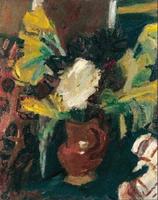
Czóbel Csendélet..
Bela Czobel
Still life with fruit plate
Paul Gauguin
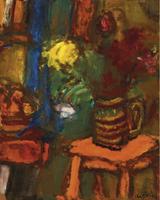
Czóbel Béla Műtermi Csendélet Virágokkal, Olaj Vászon,81x65cm
Bela Czobel
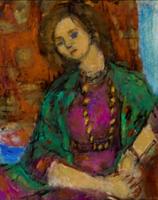
Czóbel Béla Mimi
Bela Czobel
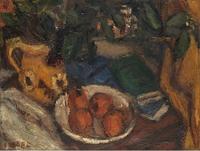
Czobel Bela Csendélet Gyümölcsel 40x65cm
Bela Czobel
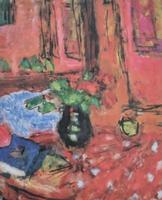
Czobel Béla, Virág Tükör Elött, 1974
Bela Czobel