
Expertenanalyse zu Bela Czobels View of a Street at Hatvan
Stil: Expressionism · Genre: cityscape
Expert Analysis of "View of a Street at Hatvan" by Béla Czobel
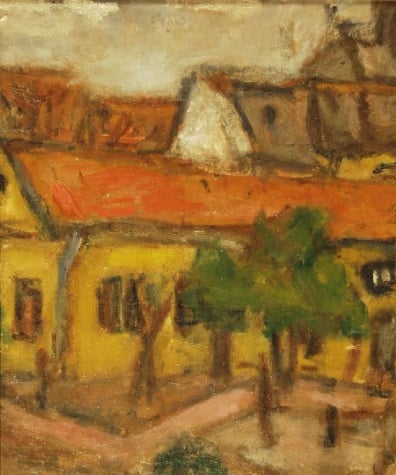
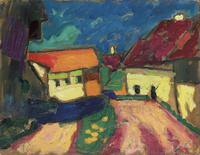
Béla Czobel’s View of a Street at Hatvan is a compelling example of Hungarian Expressionism, a movement that sought to convey emotional experience over naturalistic representation. Painted as a cityscape, the work transforms an ordinary provincial street into a charged, subjective vision—revealing Czobel’s departure from the more restrained naturalism of his early training at the Nagybánya school.
Significance within Expressionism
The painting’s significance lies in its synthesis of two key Expressionist impulses: bold, non‑naturalistic color and distorted spatial perspective. Czobel uses the street as a stage for emotional intensity, likely employing vibrant, clashing hues—such as deep blues, fiery oranges, or stark greens—to evoke the mood of a particular moment rather than a literal scene. The artist’s loose, energetic brushwork pushes the architecture and figures toward abstraction, emphasizing the psychological resonance of the built environment. This approach aligns with the broader Expressionist goal of externalizing inner states, making the street a reflection of the artist’s own subjective experience.
Czobel’s Role in Hungarian Modernism
Czobel was a pivotal figure in early 20th‑century Hungarian modernism. After studying in Munich and Paris, he absorbed Fauvist colorism and then moved toward a distinctly Central European Expressionism. In View of a Street at Hatvan, this hybrid influence is evident: the composition retains the local identity of Hatvan (a town in rural Hungary) while demonstrating a sophisticated, international avant‑garde vocabulary. The work thus stands at a crossroads—between provincial subject matter and a cosmopolitan, emotionally charged style—marking Czobel’s contribution to bringing Expressionism into Hungarian cityscape painting.
What Makes It Notable
- Emotional topography: The street is not a mere record but a conduit for feeling—likely anxiety, vitality, or melancholy, common themes in Expressionist urban views.
- Color as narrative: Without relying on anecdotal details, Czobel uses palette and texture to suggest a specific atmosphere (e.g., the heat of a summer afternoon or the tension of a cramped lane).
- Formal boldness: The distortion of perspective (such as exaggerated tilting or foreshortening) and the simplification of forms into angular or sweeping shapes place the work in dialogue with contemporaries like Ernst Ludwig Kirchner or Oskar Kokoschka, yet with a uniquely Hungarian sensibility.
In summary, View of a Street at Hatvan is significant because it exemplifies how Hungarian Expressionism translated a humble townscape into a vibrant, introspective statement—merging local character with the radical visual language of early 20th‑century modernism. Czobel’s street is not a window onto reality but a mirror of the artist’s inner world.
Genre
Stil
Visuell ähnlich
20 Werke mit ähnlicher Komposition und Farbpalette
Béla Czóbel, Szentendre
Bela Czobel
Czóbel Szentendre
Bela Czobel
Bela Czobel, Szentendrei Házak 1950
Bela Czobel
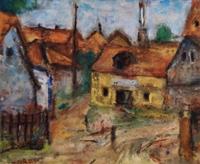
Szentendre
Bela Czobel
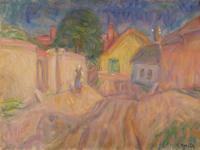
Curved Street at Szentendre
Kmetty János
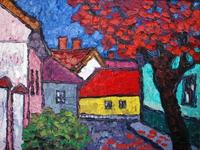
Streets meeting on Baja
Endre Bartos
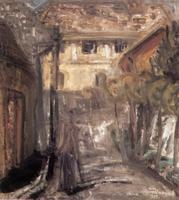
Houses with Crippled Man
Istvan Ilosvai Varga
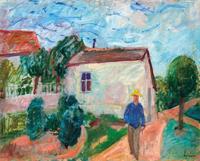
Berény Róbert Kertben Sétáló
Berény Róbert
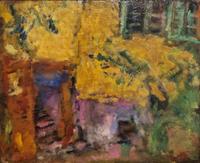
Béla Czóbel, Window in Szentendre, 1975
Bela Czobel
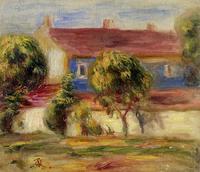
The Artist s House
Pierre-Auguste Renoir
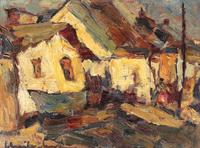
Fringe of Bucharest
Rudolf Schweitzer-Cumpana
Bela Czobel, 1920 Lombok Közt
Bela Czobel
Czóbel Szentendre
Bela Czobel
Landscape from Caransebes
Corneliu Baba
Landspace with a Walking Figure
Kmetty János
Hauptstrasse (Mit Mann)
Gabriele Munter
Belgrade Suburb
Nadezda Petrovic
Szentendre
Bela Czobel
Paysage
Bela Czobel
Landschaftstudie - Dorfstrasse
Alexej von Jawlensky