
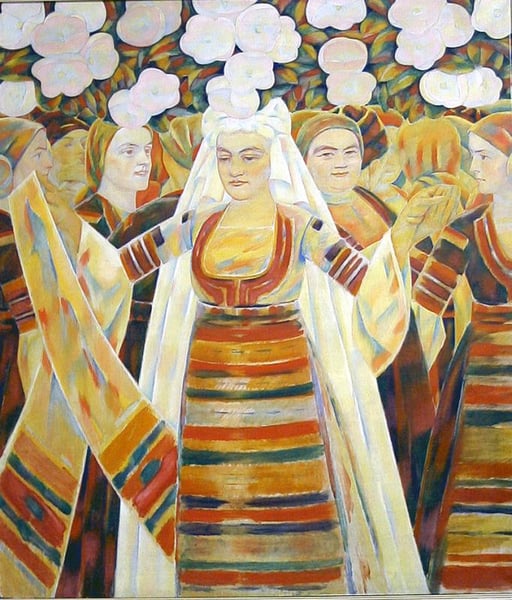
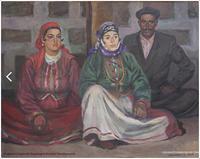
Harvester women
Analyse experte de Harvester women de Vladimir Dimitrov
Style : Post-Impressionism · Genre : genre painting
The painting "Harvester Women" by Vladimir Dimitrov stands as a powerful example of how Post-Impressionism was adapted to express the dignity and vitality of rural life. Dimitrov, a leading figure in early 20th-century Bulgarian art, is celebrated for his bold use of color and rhythmic, simplified forms—hallmarks of his personal style that blend Post-Impressionist structure with a distinctly Balkan sensibility.
Significance within Post-Impressionism:
- Dimitrov’s work reflects the Post-Impressionist drive to move beyond naturalistic representation, using color and composition to convey emotion and symbolic meaning. In "Harvester Women," the artist likely employs saturated, non-naturalistic hues (a trait shared with Fauvism and the Nabis) to elevate the everyday act of harvesting into a timeless, almost ritualistic scene.
- The genre painting format—depicting peasant laborers—was common among Post-Impressionists like Van Gogh and Gauguin, who saw rural communities as repositories of authenticity and spiritual connection. Dimitrov’s treatment avoids sentimentality; instead, his strong outlines and flattened planes emphasize the women’s physical strength and rhythmic unity with the landscape.
Cultural and Artistic Legacy:
- As a Bulgarian artist, Dimitrov synthesized Western European Post-Impressionist techniques with local folk traditions, including the vibrant patterns and earthy tones found in Bulgarian iconography and rural textiles. This makes "Harvester Women" not only a genre scene but also a nationalistic statement, celebrating the resilience and beauty of Bulgarian peasantry during a period of rapid modernization.
- The painting is significant for its monumental yet intimate portrayal of female labor. The women are neither idealized nor victimized; they appear as active, harmonious participants in an age-old cycle, their bodies integrated with the land. This reflect Dimitrov’s humanistic vision—often called “the Master” in Bulgaria—and his belief that art should honor the ordinary person.
In sum, "Harvester Women" is a key work that demonstrates how Post-Impressionism could be reinvented outside Western Europe, using its formal devices to articulate a unique cultural identity while upholding the movement’s core values of expressive color, emotional resonance, and reverence for the everyday.
Genre
Style
Visuellement similaire
20 œuvres à la composition et à la palette proches
Untitled
Vladimir Dimitrov
Czene Béla, Uton a Templomba 1946
Czene Béla

Untitled
Vladimir Dimitrov
Untitled
Vladimir Dimitrov
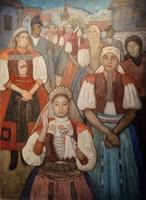
Czene Béla, Kalotaszegi Lányok 1947
Czene Béla
Two girls
Nicholas Roerich
Solveig
Nicholas Roerich

Farandole
Filipp Malyavin
Berendeyki
Viktor Vasnetsov
Untitled
Vladimir Dimitrov
Hay girls
Konstantin Korovin
Peasants of Abrud
Ion Theodorescu-Sion

Mulher portuguesa
Lilian Greisse
The scene with seven figures in costumes
Nicholas Roerich
Kupava
Viktor Vasnetsov
Girls
Nicholas Roerich

Illustration for The Ural Tales
Vyacheslav Nazaruk
Hulder
Theodor Severin Kittelsen
Three Sisters - Allegory of Unity - Mizia, Thrace and Macedonia
Ivan Mrkviсka
Kurdish family
Mariam Aslamazian