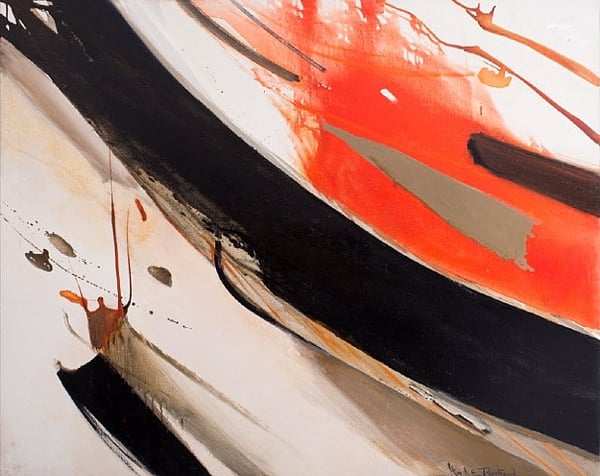
Экспертный разбор работы «J'ai dit noir puis rouge puis noir encore» художника Huguette Arthur Bertrand
Стиль: Tachisme · Жанр: abstract
Expert Analysis: "J'ai dit noir puis rouge puis noir encore" by Huguette Arthur Bertrand
Huguette Arthur Bertrand’s "J'ai dit noir puis rouge puis noir encore" is a compelling example of Tachisme, the French post-war abstract movement that emphasized spontaneous, gestural mark-making and the primacy of color and texture over form. The title—French for “I said black then red then black again”—offers a rare, almost poetic glimpse into the artist’s creative process, treating the painting as a sequential, almost musical declaration of hues.
Significance within Tachisme
While Tachisme is often overshadowed by its American counterpart, Abstract Expressionism, Bertrand’s work stands out for its disciplined reduction of palette and visceral orchestration of gesture. Unlike the explosive, all-over compositions of Pollock or the atmospheric color fields of Rothko, Bertrand concentrates on a stark interaction of just two colors—black and red—creating a tensive dialogue that mirrors the movement’s core interest in matière (materiality) and l’informe (the formless). The repeated “noir” bookends the “rouge,” suggesting a rhythmic oscillation between presence and absence, figure and ground, order and chaos.
Bertrand was one of the few prominent female artists in the largely male-dominated Tachiste circle (including Pierre Soulages, Hans Hartung, and Georges Mathieu). Her bold use of a restricted palette subverts the period’s expectation of chromatic explosion, demonstrating that abstraction could achieve emotional intensity through restraint. The title itself—an imperative or a recollection of an action—invites the viewer to imagine the artist’s hand moving across the canvas, each stroke a decisive utterance.
What makes this artwork significant
- Iterative process as content: The title explicitly describes the act of painting in temporal sequence (“then… then again”), turning the work into a document of its own creation—a hallmark of Tachisme’s focus on the artist’s spontaneous action.
- Color as semantic force: Black and red carry potent associations (life/death, passion/void, presence/absence). By forcing them into direct confrontation, Bertrand achieves a lyrical intensity without resorting to narrative symbolism.
- Gender and legacy: At a time when Tachisme was largely defined by male artists, Bertrand’s rigorous abstraction and command of tonal economy help expand our understanding of the movement’s diversity. Her work challenges the idea that gestural abstraction must be overtly aggressive or expansive—it can also be intimate, meditative, and dialectical.
In sum, "J'ai dit noir puis rouge puis noir encore" is significant for its conceptual self-awareness (the title as score), its mastery of limited means, and its contribution to a more inclusive history of Tachisme, where color and gesture become a personal grammar of visual declaration.
Визуально похожие
20 работ с близкой композицией и палитрой
Gratitude
Toko Shinoda
Phenomena Intervening Mantle
Paul Jenkins
Town
Nemanja Vučković
Untitled 2447
Luis Feito
L'amant cachalot
Huguette Arthur Bertrand
Purple Mountain
Judith Godwin
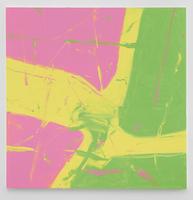
Untitled
Michel Majerus
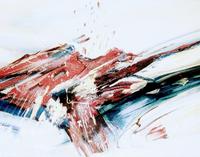
LOS PÁJAROS CAÍDOS DEL CIELO
Emil Grigoras
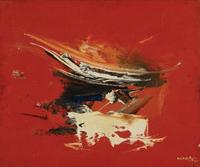
Passage de Fuego
Manabu Mabe
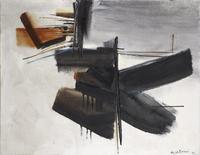
Mayou
Huguette Arthur Bertrand
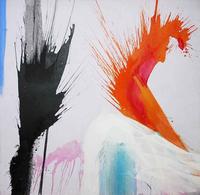
Pink Maple
Ed Clark
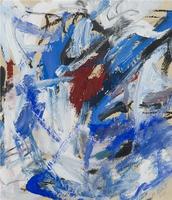
Abstrakter Expressionismus
Mary Abbott
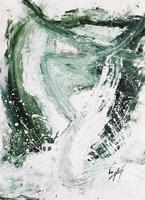
Itazura Ni
Kazuo Shiraga
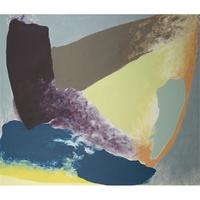
Sanctum
Friedel Dzubas
Untitled
Joan Mitchell
Orbit
Judith Godwin
Composition III
Monique Orsini
Symphony
Joan Snyder
Hilights
Walter Darby Bannard
Blue Force
Ed Clark