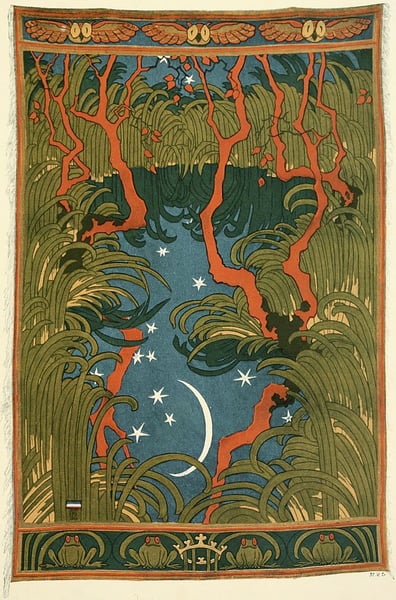
Waldteich
Analisi esperta di Waldteich di Otto Eckmann
Stile: Art Nouveau (Modern) · Genere: illustration
Expert Analysis of "Waldteich" by Otto Eckmann
Otto Eckmann’s "Waldteich" (Forest Pond) is a quintessential example of German Jugendstil, the regional variant of Art Nouveau. Created as an illustration, the work embodies the movement’s core ideals: a harmonious fusion of nature, ornament, and graphic simplicity.
Significance within Art Nouveau
- Organic Abstraction: Eckmann masterfully reduces natural forms—trees, water, foliage—into sinuous, rhythmic lines. The pond’s surface likely ripples in flowing, parallel curves, while trees twist into elegant, whip-like silhouettes. This stylization is a hallmark of Art Nouveau’s rejection of literal representation in favor of decorative, life-infused patterns.
- Flatness and Decorative Unity: As an illustration, "Waldteich" embraces a two-dimensional, patterned quality. Eckmann flattens space, eliminating deep perspective to create a cohesive ornamental surface. The pond, sky, and forest become interlocking motifs, reflecting Art Nouveau’s ambition to dissolve boundaries between fine art and design.
- Symbolism and Subject: The forest pond is a classic Art Nouveau theme—a tranquil, mystical landscape that evokes the era’s fascination with nature as a source of spiritual renewal. Eckmann’s treatment transforms a simple scene into a dreamlike emblem of organic unity.
Eckmann’s Role in Jugendstil
Eckmann was not only a painter but a pioneering graphic designer and typeface creator (e.g., Eckmann-Schrift). His illustrations, often published in journals like Jugend or Pan, helped disseminate Jugendstil aesthetics to a broad audience. "Waldteich" exemplifies his skill in balancing meticulous linework with atmospheric suggestion—a technique that influenced later poster and book illustration.
Legacy
The work’s significance lies in its demonstration of how Art Nouveau’s decorative principles could elevate a humble natural scene into an iconic, visually harmonious statement. It remains a touchstone for the movement’s synthesis of art, nature, and design.
Visivamente simili
20 opere con composizione e palette affini
The River
Brett Whiteley
Landscape with Yellow Birds
Paul Klee
Snow Queen
Kay Nielsen
Aubusson tapestry
Raoul Dufy
A good tree has grown
Nicholas Roerich
Untitled
Paul Ranson
Juniper Tree
Kay Nielsen
Taste of the abyss
Pierre Alechinsky
Flower myth
Paul Klee
Girl and Leshy
Maria Yakunchikova
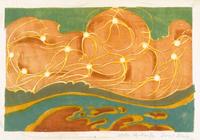
Watersprites
Dorrit Black
La première Trompette. La grêle de feu mêlée de sang. Apoc. VIII
Facundus
Cottlesbridge Landscape
Dale Hickey
Untitled
Paul Ranson
Arinkarakaraka
Clifford Possum Tjapaltjarri
Green Mist
Eyvind Earle
Good nest (Good tree, consolation for eyes)
Nicholas Roerich
Violette Consented Willingly to Pass the Night in the Forest.
Virginia Frances Sterrett
Red Graze
Sonya Rapoport
Veil
Kazimir Malevich