Analyse experte de Wallpaper design de Otto Eckmann
Style : Art Nouveau (Modern) · Genre : design
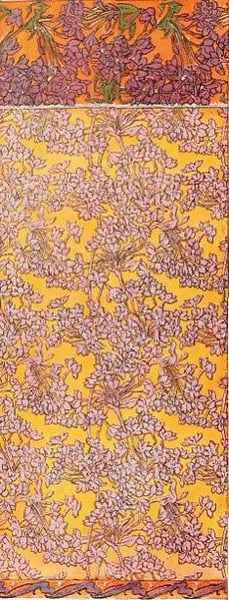
Expert Analysis of "Wallpaper Design" by Otto Eckmann
Otto Eckmann’s Wallpaper Design is a quintessential example of the Art Nouveau movement's revolutionary approach to decorative arts, specifically within the German Jugendstil branch. Its significance lies in how it transforms a functional, domestic object into a vehicle for avant-garde artistic expression, embodying the period’s central tenet: the synthesis of art and everyday life.
Stylistic Significance: Typical of Art Nouveau, Eckmann’s design rejects historical revivalism in favor of a new, modern aesthetic rooted in nature. The wallpaper likely features flattened, undulating organic forms—most probably stylized stems, leaves, or flowers—whose rhythmic, curvilinear lines create a sense of continuous, flowing movement. This “whiplash” curve, a hallmark of the style, is not merely decorative; it reflects a dynamic, almost biological energy that animates the surface. Unlike earlier patterns that sought to imitate natural textures, Eckmann abstracted natural motifs into elegant, graphic symbols, anticipating the simplification of form seen in early 20th-century Modernism.
Innovation in Design: Eckmann was a pioneer in elevating the status of applied arts during the Jugendstil period. His wallpaper designs were integral to the larger mission of the Darmstadt Artists’ Colony and the Die Jugend journal (which gave Jugendstil its name). By creating repeat patterns that could be mass-produced, he demonstrated that high artistic ideals could merge with industrial production. The design’s flat, two-dimensional quality—avoiding depth or shading—respects the physical nature of a wallpaper’s surface, while its asymmetrical yet balanced composition challenges traditional symmetry, giving the room a fresh, modern sensibility.
Historical Context and Legacy: Eckmann’s work marks a critical shift in European design philosophy. Before Art Nouveau, wallpapers often mimicked textile patterns or historical ornaments; after Eckmann, the pattern itself became an organic, artistic statement. His designs influenced the Vienna Secession and later Wiener Werkstätte, and their emphasis on linear abstraction paved the way for the geometric simplicity of the Bauhaus. Moreover, Eckmann’s belief that “even a wallpaper can be a work of art” helped demolish the hierarchy between fine arts and craft, a legacy that resonates in modern interior design.
In sum, Wallpaper Design is significant not as a mere decorative sample, but as a manifesto of the Jugendstil ideal: a harmonious, stylized nature brought into the home, where every surface could sing with the same artistic integrity as a painting or sculpture. It demonstrates how Art Nouveau turned the ordinary into the extraordinary, and how Eckmann’s vision helped define the modern aesthetic.
Visuellement similaire
20 œuvres à la composition et à la palette proches
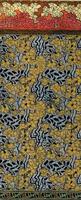
Wallpaper design
Otto Eckmann
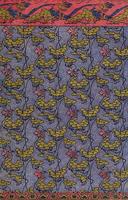
Wallpaper design
Otto Eckmann
Jamboree
Robert Zakanitch
Ebru (attributed)
Hatip Mehmed Efendi
Untitled (Hudson Mohawk Rugs)
Pearl Blauvelt
Red Graze
Sonya Rapoport
Possum Dreaming
Clifford Possum Tjapaltjarri
Cascade II
Robert Zakanitch
White Daisies Rhapsody
Alma Woodsey Thomas
Modok Mária, Képkonstrukciók
Modok Mária
Wurstweg
Christian Attersee
Progetto per un telo
Enrico Baj
Lightning Dreaming
Clifford Possum Tjapaltjarri
Kadmiumrot - Picadilly
Kuno Gonschior
When I Was Young
Louise Bourgeois
Paths
Leon Ferrari
Between Space and Time
Mark Tobey
Recitals
Sam Gilliam
Abstract 1991-8
Yu Youhan
Fish drawn on the sand
Andre Masson