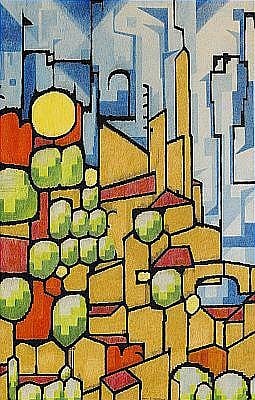
Otto Gustav Carlsund の Staden på berget の専門的な分析
スタイル:Cubism · ジャンル:cityscape
Expert Analysis: "Staden på berget" by Otto Gustav Carlsund
As a work from the hand of Otto Gustav Carlsund—a pivotal figure in Swedish modernism and a direct pupil of Fernand Léger and Amédée Ozenfant—"Staden på berget" (The City on the Mountain) represents a rare synthesis of late Cubist structure and Purist idealism. Executed in the Cubist style and classified as a cityscape, this painting transcends mere landscape representation to become a manifesto of order, clarity, and modern urban vision.
Stylistic Significance within Cubism
Carlsund’s Cubism is not the analytical fragmentation of Picasso and Braque from the early 1910s, but a later, more architectonic variant heavily influenced by the Purist movement he embraced in Paris. In "Staden på berget", the city is reduced to a series of planar, geometric volumes—cubes, cylinders, and rectangular slabs—stacked and interlocked along a diagonal rise. The “mountain” is not a natural landform but a constructed, stepped pyramid of buildings, echoing the Cubist fascination with multiple perspectives. Yet Carlsund tames Cubism’s inherent chaos: his lines are clean, his palette restrained (likely earth tones, grays, and muted primary accents), and his composition rigorously balanced. This places the work at the threshold where Cubism yields to abstraction and architectural precision.
Genre as Urban Utopia
The cityscape genre here is deployed not as a depiction of a specific location but as a universal symbol of modernity. Carlsund’s city on a hill is an ideal, ordered community—a Purist vision of harmony between human-made forms and the landscape. The mountain itself becomes a pedestal for a rational, machine-age civilization. This aligns with Carlsund’s role in the Swedish avant-garde group Art Concret and his advocacy for a “constructive” art that could shape society. The painting’s significance lies in its demonstration that Cubism could be adapted to convey optimism and structure rather than fragmentation, prefiguring the geometric abstraction and concrete art that would dominate mid-century Scandinavian modernism.
Art-Historical Context
As one of the first Swedish artists to fully absorb and reinterpret Cubism and Purism after studying in Paris, Carlsund used "Staden på berget" to bridge European avant-garde currents and Nordic sensibilities. The work is significant for illustrating how Cubism was translated into a Northern European context: less cerebral and more architectonic, less distorted and more ordered. It stands as a key example of how the Cubist language was repurposed for utopian cityscapes in the 1920s and 1930s, influencing later Swedish Functionalism in architecture and design.
In sum, "Staden på berget" is significant not only for its technical mastery of Cubist principles but for its embodiment of a moment when art sought to rebuild the world—literally, stone by painted stone—into a rational, beautiful, and modern whole.
視覚的に類似
構図やパレットが近い作品 20 件
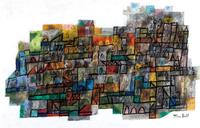
Jerusalem
Jean David
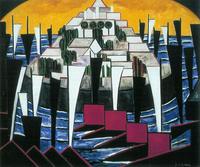
Bild no. 15, Berg und Schiffe
Jacoba van Heemskerck
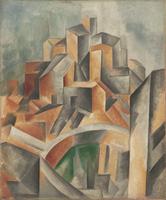
The Reservoir, Horta de Ebro
Pablo Picasso
Untitled
Pablo Picasso
Choosen site
Paul Klee
Cidade
Claudio Tozzi
839 The Third Skin
Friedensreich Hundertwasser
New York Cityscape
Charles Alston
Untitled
Hans Hofmann
Souvenirs from the Citadel
George Stefanescu
553A Street for Survivors
Friedensreich Hundertwasser
Estación submarina
Alice Rahon
Full moon
Paul Klee
Landscape with Chimneys
Albert Gleizes
The Village
Jean Metzinger
The sunset
Sven Jonson
The Western Wall
Mordecai Ardon
The great tug
Fernand Leger
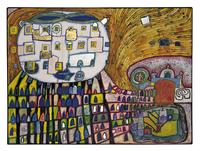
906 Domestic Cat – The Cat of Atlantis
Friedensreich Hundertwasser
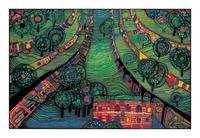
781 Green Town
Friedensreich Hundertwasser