Analisi esperta di The Holy Family di Francisco Bayeu y Subias
Stile: Neoclassicism · Genere: religious painting
Expert Analysis: "The Holy Family" by Francisco Bayeu y Subias
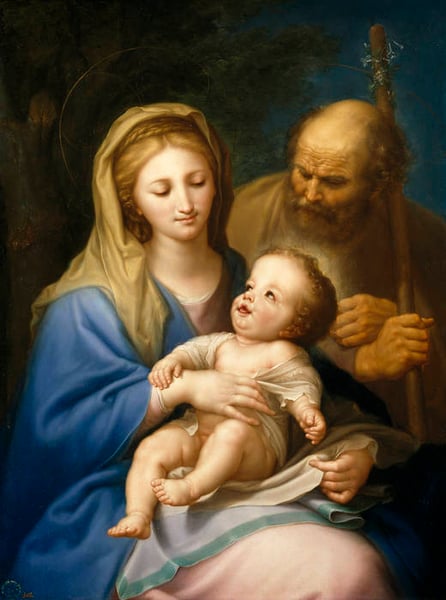
Francisco Bayeu y Subias’s The Holy Family stands as a compelling example of Neoclassical religious painting, a genre that sought to reconcile spiritual subject matter with the era’s Enlightenment ideals of clarity, order, and moral restraint. Produced at a time when Spanish art was transitioning from the ornate drama of the Baroque to the sober rationality of Neoclassicism, this work highlights Bayeu’s role as a pivotal figure—both as a court painter and as the brother-in-law and early mentor of Francisco Goya.
Significance within Neoclassicism
Bayeu’s composition adheres to the Neoclassical principles of balanced composition, clear contours, and restrained emotion. The holy figures—likely the Virgin Mary, the Christ Child, and Saint Joseph—are arranged in a stable, triangular grouping, a compositional device derived from Renaissance masters like Raphael, which Neoclassicists revered as the pinnacle of harmony. The drapery is sculptural, falling in clean, parallel folds that emphasize the body’s underlying structure rather than decorative flourishes. The palette is subdued, with soft earth tones and cool blues, avoiding the intense chiaroscuro of the Baroque in favor of even, diffused light that conveys a serene, timeless atmosphere.
Significance as a Religious Painting
As a religious work, The Holy Family embodies the Neoclassical goal of moral edification through clarity and decorum. Unlike earlier, more emotive depictions of the Holy Family (such as those by Murillo), Bayeu’s figures are dignified and contemplative, their gestures restrained. The Christ Child may reach toward the viewer or the Virgin with a gesture that implies blessing, yet the expression is calm, not playful. This aligns with the Enlightenment belief that art should appeal to reason and virtue rather than passionate piety. The painting’s quiet reverence invites the viewer to reflect on the sacred family’s humanity and divinity simultaneously—a central tenet of Counter-Reformation theology now expressed through Neoclassical austerity.
Broader Artistic Context
Bayeu’s work is significant as a bridge between the last gasp of the Spanish Baroque and the emerging Neoclassical taste at the Spanish court of Charles III. While his frescoes for the Royal Palace of Madrid demonstrate the grand, mythological themes favored by the court, The Holy Family shows his ability to treat a traditional devotional subject with the formal discipline and intellectual clarity that Neoclassicism demanded. In doing so, Bayeu helped establish a standard for Spanish religious painting that would influence younger artists, including Goya, who would later subvert these very ideals. The painting thus stands as a masterful example of how Neoclassicism could serve spiritual ends without sacrificing compositional rigor or emotional restraint.
Visivamente simili
20 opere con composizione e palette affini
Madone Et Enfant Avec Deux Anges
Giambattista Pittoni
The Holy Family
Francisco Goya
The Virgin and Child with Saint John
Jacopo Amigoni
MARIA MIT DEM KIND UND DEM JOHANNESKNABEN
Hans Rottenhammer I
MADONNA AND CHILD
Pietro de' Pietri
Holy Family with Young Saint John
Il Sodoma
The Madonna of the Basket
Correggio
The Holy Family with Saint Jerome
Correggio
The Virgin and Child with the Infant St John the Baptist
Francisco de Zurbaran
Holy Family with Mary Magdalene
Ventura Salimbeni
Madonna and Child and Saint John the Baptist
Hans Rottenhammer I
The Mystic Marriage Of Saint Catherine Of Alexandria
Francisco de Zurbaran
Madonna and Child
Joseph Paelinck
The Holy Family
Raphael
Virgin and Child with an Angel
Correggio
VIRGIN AND CHILD WITH SAINT PETER
Jacopo Amigoni
Madonna Hertz
Giulio Romano
Madonna Campori
Correggio
Madonna and child
Sassoferrato
The Virgin of the Rose
Raphael