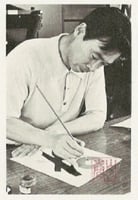
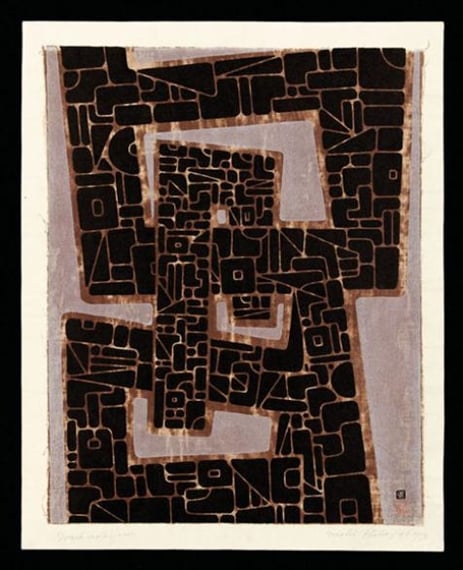
Maki Haku の Mark No. 2 (Fame) の専門的な分析
スタイル:Sōsaku hanga · ジャンル:abstract
Expert Analysis of "Mark No. 2 (Fame)" by Maki Haku
Maki Haku’s Mark No. 2 (Fame) stands as a compelling exemplar of the Sōsaku hanga movement—the "creative print" school that revolutionized Japanese woodblock printing in the 20th century. Unlike the traditional ukiyo-e division of labor (designer, carver, printer), Sōsaku hanga artists insisted on executing every stage themselves, elevating the print to a personal, expressive medium. Haku, a master of this ethos, uniquely fused the ancient discipline of calligraphy with the bold, non-representational language of abstract art.
Significance within Sōsaku hanga and Abstract Genre:
-
Calligraphic abstraction as cultural dialogue: Haku’s work is notable for its transformation of kanji characters into pure visual form. In Mark No. 2 (Fame), the character for “fame” or “name” (名) is deconstructed into sweeping, gestural strokes. The artist does not simply reproduce the letterform but amplifies its intrinsic rhythm and tension, turning legible script into an autonomous abstract composition. This bridges the gap between Eastern calligraphic tradition and Western mid-century abstraction (e.g., the gesturalism of Abstract Expressionism).
-
Woodblock as a vehicle for spontaneity: Despite the inherently meticulous process of carving woodblocks, Haku’s marks retain a sense of speed and improvisation—a paradox that defines Sōsaku hanga innovation. The uneven ink densities, the bleeding edges of strokes, and the textured grain of the wood surface all become integral visual elements. This “controlled accident” underscores the artist’s hand and the material’s voice, hallmarks of Sōsaku hanga’s core philosophy.
-
Minimalist power: The composition relies on a stark, almost monochrome palette (likely black ink on off-white paper) with a single, condensed burst of energy. The negative space is not empty but charged, acting as a foil to the dynamic mark. This economy of means—a single character, a limited print run, a simple yet profound gesture—makes Mark No. 2 (Fame) a meditation on how identity, reputation, and language can be distilled into a single, irreducible line.
In essence, Haku’s print is significant because it redefines the Japanese woodblock as a site of personal, cross-cultural modernism—where ancient calligraphic roots and radical abstraction meet in a single, forceful impression.
視覚的に類似
構図やパレットが近い作品 20 件
Untitled
Amilcar de Castro
Labirint
Gil Nicolescu
Untitled (Red and Gray)
Ad Reinhardt
Untitled
Will Barnet
Untitled
Will Barnet
Composition XIII (Woman in studio)
Theo van Doesburg
The Port
Edward Wadsworth
Untitled
Burgoyne Diller
Composition with Oval in Color Planes II
Piet Mondrian
Composition IX, opus 18, 1917
Theo van Doesburg
Untitled
Ivan Serpa
Untitled
Ad Reinhardt
Spiel und Gesetz II
Leo Leuppi
Composition
Enrico Prampolini
Festival in Spring
Toshi Yoshida
Composition#1
Valerii Lamakh
Detaliu Arhitectonic
Gil Nicolescu
Untitled
Lennart Rodhe
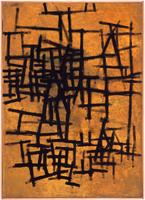
Inner View #3
Kazuo Nakamura
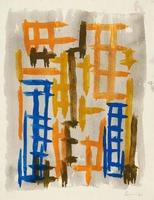
Untitled (Gitterbild)
Gunther Forg