Analisi esperta di A Hunting Ground di Hiroyuki Tajima
Stile: Sōsaku hanga · Genere: abstract
Expert Analysis: "A Hunting Ground" by Hiroyuki Tajima
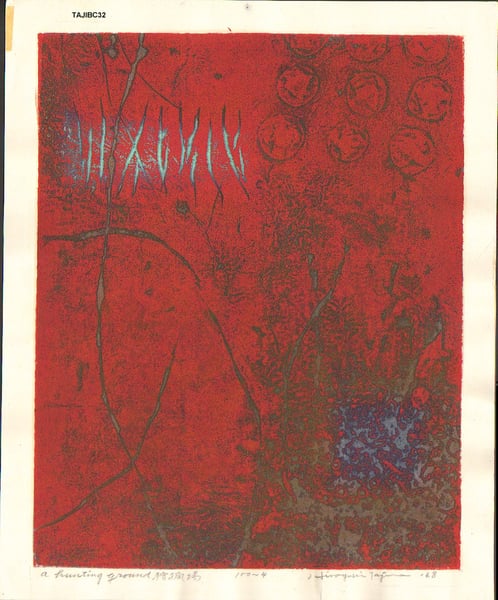
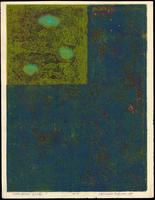
Hiroyuki Tajima’s “A Hunting Ground” is a compelling example of Sōsaku hanga (creative print) practice pushed into the realm of abstraction. Within the Sōsaku hanga movement—which broke from the traditional ukiyo-e model of artist-carver-printer collaboration—artists like Tajima took full control of every stage: designing, carving, and printing. The significance of this work lies in how it redefines the movement’s core principles through abstract form.
Despite the title’s suggestion of a literal landscape or narrative (“A Hunting Ground”), the work’s abstract genre intentionally resists direct representation. This tension is central to its meaning: Tajima uses the Sōsaku hanga’s signature materiality—the grain of the wood, the pressure of the hand, the layering of ink—not to depict a hunt but to evoke the visceral energy, rhythm, and spatial ambiguity of a contested terrain. The print becomes a metaphor for the act of creation itself: the artist “hunts” for form within the wood block.
Furthermore, the work demonstrates the movement’s ability to absorb Western modernist abstraction without abandoning Japanese printmaking traditions. Tajima’s abstract vocabulary—reduced shapes, gestural marks, and flat color fields—aligns with international avant-garde trends of the mid-20th century, yet the physical presence of hand-carved relief and subtle wood-grain textures anchors the print in Sōsaku hanga’s ethos of direct, tactile expression.
In sum, “A Hunting Ground” is significant because it expands the boundaries of Sōsaku hanga beyond figurative or landscape imagery, proving that the movement’s philosophy of “self-drawn, self-carved, self-printed” could yield powerful, non-representational works. It stands as a bridge between Japanese print heritage and global abstraction, celebrating the maker’s hand while freeing the eye to roam an abstract wilderness of color and texture.
Visivamente simili
20 opere con composizione e palette affini
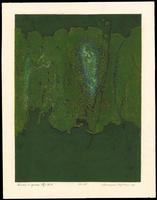
Winter in Green
Hiroyuki Tajima
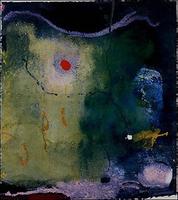
The Other Side of the Moon
Helen Frankenthaler
Untitled
Francisco Toledo
Bathroom in the Morning - Hanga Vol. 13
Koshiro Onchi
Abstraction
Beauford Delaney
Tablecloth VI
Pavlo Makov
Untitled
Cy Twombly
Graffiti- matèries
Modest Cuixart
Stars in Snails' Sexes
Joan Miro
Landscape (late autumn)
Alfred Freddy Krupa
Ignes Fatui
Boris Margo
Batement II
Joan Miro
Untitled
Luciano Bartolini
Tablecloth IV
Pavlo Makov
Brown Wall
Hiroyuki Tajima
Uno spazio nuovo
Antonio Corpora
Untitled 6
Wols
Untitled
Wols
Little Flower
Hiroyuki Tajima
Sunblinded
Perle Fine