Expertenanalyse zu Hiroyuki Tajimas Tsunagagia
Stil: Sōsaku hanga · Genre: abstract
Expert Analysis of Hiroyuki Tajima’s Tsunagagia (Sōsaku hanga, Abstract)
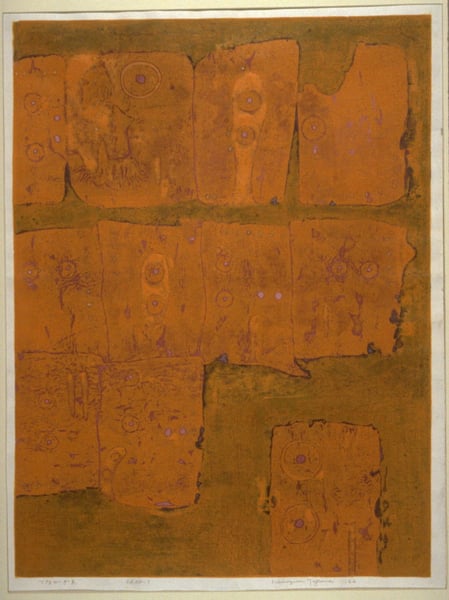
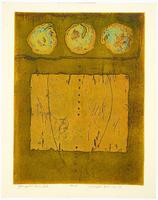
Hiroyuki Tajima’s Tsunagagia stands as a compelling example of how the Sōsaku hanga (“creative print”) movement—which broke from the collaborative ukiyo‑e tradition to emphasize the artist’s complete hand in design, carving, and printing—evolved into pure abstraction. In this work, Tajima pushes the genre beyond figuration and narrative, focusing instead on the intrinsic qualities of the woodblock medium itself.
Significance within Sōsaku hanga and Abstract Printmaking
The title Tsunagagia (likely a neologism evoking “connection” or “linkage”) signals the work’s core concern: the interplay between organic form and structural rhythm. Tajima harnesses the woodblock’s materiality—the grain of the plank, the resistance of the chisel, the uneven absorption of pigment into handmade washi paper—to generate a visual vocabulary of flowing, gestural shapes and interlocking fields of color. This is characteristic of the later phase of Sōsaku hanga, when artists like Tajima, inspired by post‑war international abstraction, began to treat the print as an autonomous, painterly object rather than a reproductive illustration.
What makes Tsunagagia particularly significant is its fusion of controlled technique and spontaneous expression. Tajima’s carving is precise, yet the inked areas retain the tactile evidence of his hand—slight burrs, uneven pressure, and the subtle bleeding of pigment into the paper. These imperfections are celebrated, not hidden, echoing the Japanese aesthetic of wabi‑sabi while also aligning with Western Abstract Expressionism’s valorization of process. The composition likely avoids symmetrical balance in favor of a dynamic, almost cellular connectivity: shapes float, overlap, and entwine, suggesting both biological growth and musical harmony.
In the context of Sōsaku hanga history, Tsunagagia represents a radical departure from the movement’s early preoccupation with landscapes and portraits. By embracing non‑representational imagery, Tajima affirms that the woodblock print can be as conceptually ambitious and emotionally resonant as any painting or sculpture. The work reaffirms the medium’s capacity to embody pure artistic intention—a core tenet of Sōsaku hanga—while simultaneously engaging with global modernist dialogues.
Ultimately, Tsunagagia is significant because it redefines the boundaries of Japanese printmaking: it is at once deeply rooted in the manual traditions of carving and printing, and utterly contemporary in its abstract, open‑ended visual language. Tajima demonstrates that the hanga artist need not be bound by subject matter; the very act of cutting, inking, and pressing can become the subject itself.
Visuell ähnlich
20 Werke mit ähnlicher Komposition und Farbpalette
Two Exiles
Hiroyuki Tajima
Little Flower
Hiroyuki Tajima
The Magnificent
Richard Pousette-Dart
Untitled
Keith Haring
Tierra de sión
Modest Cuixart
Artificial Flower on a Naples Yellow Background
Ilka Gedo
Little Moon Men
Karel Appel
Chavade
Richard Pousette-Dart
Red Balloon
Paul Klee
La Louisiane
Francois Arnal
Yellow Print
Hiroyuki Tajima
Terra de Bassora
Modest Cuixart
Untitled
Richard Diebenkorn
no title
Ben Vollers
Untitled
Hannelore Baron
Entre deux villes
Zao Wou-Ki
The Tormentors
Philip Guston
Estructuras
Gunther Gerzso
Untitled
Gunther Gerzso
The Observer
Arshile Gorky