Expert analysis of Manuel Rivera’s Espejo del Duende
Style: Art Informel · Genre: abstract
Expert Analysis of Espejo del Duende (Mirror of the Elf/Goblin) by Manuel Rivera
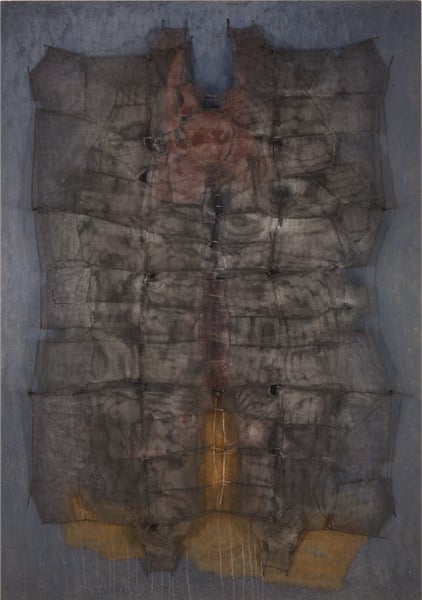
Within the framework of Art Informel—a post‑World War II European movement that privileged spontaneity, materiality, and the raw physical gesture over premeditated form—Manuel Rivera’s Espejo del Duende stands as a compelling example of the style’s turn toward abstract material poetics.
The work, executed in the abstract genre, does not depict a recognizable image but rather offers a surface of dense, layered textures that evoke the elusive, almost spectral presence suggested by its title (“Mirror of the Elf”). In Art Informel, the canvas becomes a field of action rather than a window onto reality; Rivera here treats the medium as a tactile, almost sculptural substance. The paint is applied in thick, irregular strokes, sometimes scraped, smeared, or incised, creating a topography of ridges and hollows. This aggressive handling of material echoes the movement’s debt to Jean Fautrier and Jean Dubuffet, who championed art brut and the primacy of matière.
What makes Espejo del Duende particularly significant within Art Informel is its dialectic between surface reflection and depth. The title’s reference to a “mirror” suggests a desire to capture something fleeting, perhaps the duende—a Spanish term for mysterious, earthbound spirit often invoked in flamenco and literature (as by García Lorca). Rivera’s abstraction does not illustrate that spirit but rather enacts its volatility through the paint’s own material life. The monochromatic or near‑monochromatic palette, typical of his work from this period, forces the viewer to attend to variations in light and shadow across the impasto, creating a shimmer that mimics the flickering, ungraspable quality of a mirror’s reflection.
Moreover, Rivera belonged to the influential Grupo El Paso (Madrid, 1957–1960), which brought Spanish Art Informel to international attention. Espejo del Duende embodies the group’s commitment to expressive freedom and their rejection of both academic naturalism and geometric abstraction. The artwork’s significance lies in its refusal of any fixed meaning: the viewer is invited to project, to “see” shapes or ghosts in the agitated surface, much as one might glimpse a face in a mottled wall. In this sense, the painting is not a representation but an evocation—a mirror that reflects not the world but the act of seeing itself.
In summary, Espejo del Duende is a masterwork of Art Informel because it collapses the boundary between material and spirit, gesture and meaning. It captures the movement’s core ambition: to make paint a vehicle for raw, existential presence, where the abstract is never empty but always charged with the invisible.
Genre
Style
Visually similar
20 works with related composition and palette
Metamorphosis (Medieval)
Manuel Rivera
Metamorfosis (Espejo Roto)
Manuel Rivera
Untitled
Sorin Dumitrescu
Espejo Herido XV
Manuel Rivera
Untitled
Charles Garabedian
Grey Ochre
Antoni Tapies
Collage
Hannelore Baron
Jute IV
Jean-Paul Riopelle
Untitled
Sam Gilliam
Composition
Alberto Burri
Alberello
Luciano Bartolini
Untitled
Hannelore Baron
Espejuelo
Manuel Rivera
Untitled
Hannelore Baron
Medeic Callisthenic Moves III
Geta Bratescu
Soul of Man
Roger Weik
Ravaged land
Paul Klee
Metamorfosis (Nocturno)
Manuel Rivera
The Ultimate Bundle (Obama's portrait)
Kaloust Guedel
Espejo Sonámbulo
Manuel Rivera