
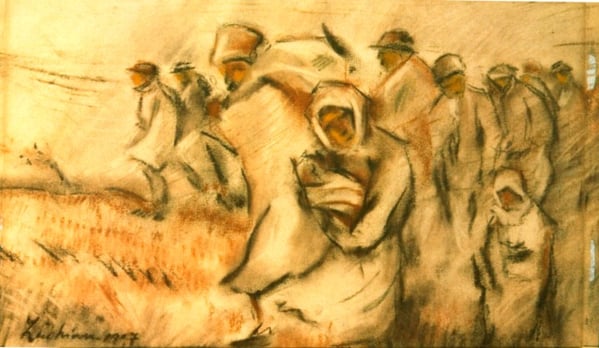
Expertenanalyse zu Stefan Luchians Insurgent Peasants
Stil: Impressionism, Social Realism · Genre: history painting
Expert Analysis: "Insurgent Peasants" by Stefan Luchian
Stefan Luchian’s "Insurgent Peasants" stands as a pivotal work that bridges two seemingly distinct artistic currents—Impressionism and Social Realism—within the genre of history painting. Its significance lies in how Luchian harnesses the luminous, broken brushwork of Impressionism not for leisurely landscapes or bourgeois scenes, but to capture the raw, collective energy of a peasant uprising, thereby transforming the language of light into a tool of social protest.
Stylistic Hybridity
Luchian adopts Impressionism’s hallmark techniques—visible brushstrokes, vibrant color contrasts, and an emphasis on natural light—yet subverts their typical subject matter. Instead of a sun-dappled garden or a Parisian boulevard, he applies these methods to a charged historical moment: the massed bodies of peasants advancing in a state of revolt. The flickering strokes and vivid hues (golden sunlight mingling with earthy browns and fiery reds) do not merely record a peaceful outdoor scene; they animate the urgency and turmoil of the crowd. This fusion makes the painting a rare instance where Impressionist visual pleasure coexists with Social Realist political intent.
Genre and Historical Context
As a history painting—traditionally the most elevated genre in academic hierarchies—"Insurgent Peasants" asserts that the struggles of ordinary rural workers are worthy of monumental treatment. Luchian was profoundly influenced by the 1907 Romanian Peasant Revolt, a violent uprising brutally suppressed by the state. By depicting insurgents rather than victims, he shifts the narrative from passive suffering to active agency. The composition likely shows peasants advancing with tools and makeshift weapons, their determined postures echoing the forward momentum of revolutionary imagery, yet individual faces are softened by Impressionist dappled light, preserving their humanity rather than reducing them to caricatures.
Significance Within Art History
The work is significant for challenging the apolitical reputation of Impressionism. Where French Impressionists often sidestepped social commentary, Luchian proves that the style could be repurposed to express solidarity with the oppressed. It also anticipates later 20th-century efforts to merge modernist technique with political content (e.g., Mexican muralists, German Expressionism). In the Romanian context, "Insurgent Peasants" is a cornerstone of national art, demonstrating that modernization need not abandon social conscience. Luchian’s synthesis—the freshness of Impressionist color allied with the gravity of Social Realism—ensures the painting remains a powerful testament to art’s capacity to both see beauty and demand justice.
Visuell ähnlich
20 Werke mit ähnlicher Komposition und Farbpalette
299
Amos Langdown
Na De Werkstaking
Jan Toorop
Devant L'Invasion
Theophile Steinlen
Laundresses Carrying Linen in Town
Edgar Degas
21870 1
Amos Langdown
H1025 L21805707
Amos Langdown
H1025 L21805707
Amos Langdown
Laundress Carrying Linen
Edgar Degas
Composition with Peasant Women
Ion Theodorescu-Sion
CON451 Vrouens En Kinders Wat Blomme Pluk 45 X 60cm ODB
Amos Langdown
CON451 Vrouens En Kinders Wat Blomme Pluk 45 X 60cm ODB
Amos Langdown
Summer Dream
Theo van Doesburg
A2
Amos Langdown
Gipsy Tent
Arthur Verona
Exode
Theophile Steinlen
The Washerwomen
Josef Herman
Amos Langdown 19190 40 X 49 George Stock
Amos Langdown
GOING HOME
Gerard Sekoto
Proletarians
Theophile Steinlen
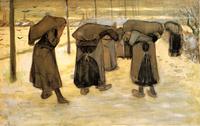
Miners' wives carrying sacks of coal
Vincent van Gogh