Analisi esperta di Dobrudjan Street di Lucian Grigorescu
Stile: Impressionism · Genere: genre painting
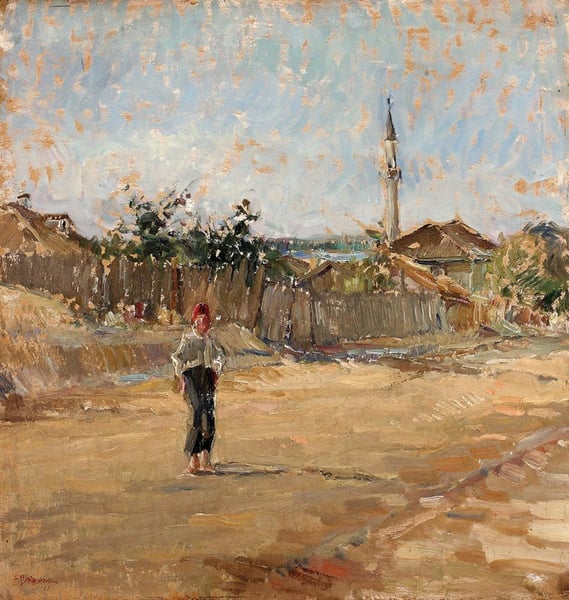
Expert Analysis: "Dobrudjan Street" by Lucian Grigorescu
Lucian Grigorescu’s “Dobrudjan Street” stands as a compelling example of how Impressionist principles were adapted to a distinctly Romanian context, making it significant both within the artist’s oeuvre and the broader European Impressionist movement. Painted as a genre scene—a depiction of everyday life—the work captures a sun-drenched street in the Dobrudja region, a historic area along the Black Sea. Grigorescu, often regarded as the leading Romanian Impressionist, here synthesizes the French Impressionist fascination with light and atmospheric effect with a local, rural subject matter, giving the movement a regional identity.
The painting likely exemplifies core Impressionist hallmarks: loose, visible brushwork that conveys the shimmer of sunlight on dusty roads and whitewashed walls; a bright, high-key palette dominated by ochres, pale blues, and warm earth tones; and a focus on a fleeting moment—perhaps peasants, carts, or a shaded marketplace—rather than a grand narrative. What makes “Dobrudjan Street” particularly significant is its role in signaling the maturation of Romanian modernism. Grigorescu studied in Paris and brought back not just technique but a sensibility that elevated ordinary, regional life (a simple street in Dobrudja) to the level of painterly poetry. This work bridges the gap between Western Impressionism’s urban, bourgeois scenes and the pastoral, folk traditions of Eastern Europe. It also affirms the artist’s skill in capturing the unique quality of southern Romanian light—dry, intense, and hazy—which differs markedly from the wetter light of coastal France.
As an Impressionist genre painting, “Dobrudjan Street” is significant for its dual achievement: it demonstrates that the impressionist method—rapid notation, emphasis on transient effects—could be applied to non-French landscapes without losing its vitality, and it provides a vivid document of early 20th-century Romanian life. Grigorescu’s work thus expanded the scope of Impressionism, proving the movement’s global adaptability and its power to convey local identity through universal visual language.
Genere
Stile
Visivamente simili
20 opere con composizione e palette affini
The Mosque in Ada Kaleh
Constantin Artachino
Noon at Brănești
Adam Baltatu
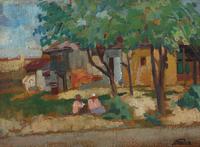
In the Shade
Francisc Sirato
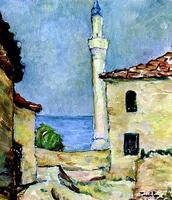
Lighthouse in Balchik
Nicolae Tonitza
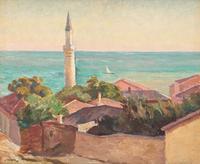
Minaret la Balcic
Samuel Mutzner
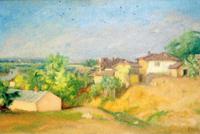
Silistra Landscape
Iosif Iser
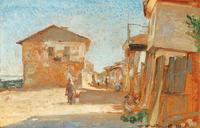
Fisherman Village in Brittany
Nicolae Vermont
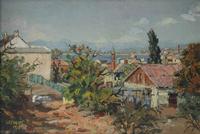
View from Signal Hill
Gregoire Boonzaier
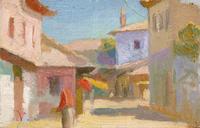
Bazaar in Anatolia
Huseyin Avni Lifij
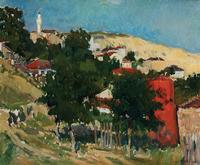
Amiază la Balcic
Jean Alexandru Steriadi
Road Towards the Drinking Fountain, Balcic
Nicolae Darascu
Village
Victor Brauner
Arab Street Scene
John Singer Sargent
Balchik Springtime
Lucian Grigorescu
Winter Landscape
Adam Baltatu
In Krasnokamenka under Gurzuf
Konstantin Korovin
Landscape with fencing
Isaac Levitan
Iași Outskirts Houses
Adam Baltatu
House on Siret Valley
Adam Baltatu
The Mosque from Turtucaia
Iosif Iser