Analisi esperta di Scroll illustrating The Heart Sutra di Qiu Ying
Stile: Gongbi · Genere: illustration
Expert Analysis: "Scroll illustrating The Heart Sutra" by Qiu Ying
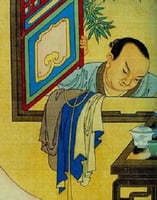
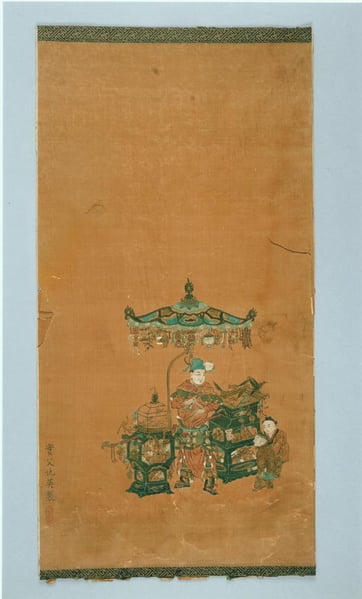
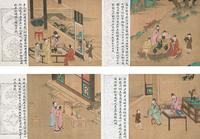
Qiu Ying (c. 1494–1552) was one of the most celebrated masters of the Ming dynasty, renowned for his dazzling command of the gongbi (meticulous brushwork) style. This scroll, which visually interprets the sacred Buddhist Heart Sutra, stands as a singular achievement in the fusion of religious text and refined pictorial narrative.
Significance within the Gongbi Style
The gongbi technique demands extraordinary precision: fine, unbroken lines, layered mineral pigments, and delicate washes. Qiu Ying’s scroll exemplifies these qualities at their peak. Every line—whether delineating the folds of a monastic robe, the petals of a lotus, or the serene expression of a bodhisattva—is executed with a controlled, rhythmic fluency. The color palette, rich with azurite, malachite, and cinnabar, is applied in even, translucent layers, creating a surface that glows with almost enamel-like intensity. This is gongbi not merely as technique, but as devotion: the act of painting becomes a meditation in itself.
Significance within Ming Dynasty Buddhist Art
During the Ming, illustrated sutras served both devotional and didactic purposes. Qiu Ying’s scroll goes beyond mere illustration; it transforms the Heart Sutra—a text about the emptiness of form—into a vivid, tangible vision. The composition likely unfolds as a continuous narrative, with Guanyin (the bodhisattva of compassion) or a dharma master expounding the sutra amid celestial beings and auspient floral motifs. By rendering abstract philosophical concepts into concrete imagery, Qiu Ying makes the scripture accessible to both literate elites and lay worshippers. This aligns with a broader Ming trend of integrating Chan (Zen) Buddhist themes with the refined tastes of the scholar-official class.
Significance as an Illustration
The scroll’s genre as “illustration” is no mere embellishment. Each scene is carefully structured to echo the sutra’s rhythmic sequence: emptiness and form, perception and non-perception. Qiu Ying uses empty space—a deliberate, unpainted ground—to suggest the “formlessness” the sutra describes, while the densely painted figures anchor the viewer in the material world. This tension between presence and absence is the crux of the Heart Sutra’s teaching, and Qiu Ying encodes it directly into the pictorial language.
Historical & Artistic Legacy
Qiu Ying’s scroll stands as a bridge between the Northern Song tradition of narrative handscrolls (like Zhang Zeduan’s Along the River During the Qingming Festival) and the increasingly refined, decorative aesthetic of later Ming court painting. It also proves that gongbi—often dismissed as merely decorative—can carry profound philosophical weight. For connoisseurs, this work is a benchmark of technical mastery; for scholars, it is a rich document of how Ming artists integrated Buddhist scripture with the highest standards of visual craft.
In sum, Qiu Ying’s "Scroll illustrating The Heart Sutra" is not just a masterpiece of meticulous painting—it is a visual sutra, where each brushstroke is a mantra, and every figure a vehicle of enlightenment.
Visivamente simili
20 opere con composizione e palette affini
Daoist deity of heaven
Wu Daozi
Street scenes newly pubished
Katsushika Hokusai
Immortals Celebrating a Birthday
Chen Hongshou
Doyeonmyeong aegukdo
Owon
The Dragon King Revering the Buddha
Chen Hongshou
Tsuchiyama
Utagawa Kuniyoshi
Daoist deity of earth
Wu Daozi
The Famous Unrivalled Hidari Jingoro
Utagawa Kuniyoshi
Seven Gods of Good Fortune
Hakuin Ekaku
Storytelling
Owon
Detail
Chen Hong
Daoist deity of water
Wu Daozi
A scene of Journey to the West
Tsukioka Yoshitoshi
Kôteiken
Utagawa Kuniyoshi
挥扇仕女图
Qian Xuan
The Eight Noble Officials
Chen Hong
鬼趣图
Qian Xuan
Yang Guifei Mounting a Horse
Qian Xuan
圣贤事迹2
Qian Xuan
Suiko gogyô
Toyota Hokkei