
Expertenanalyse zu Andre Dunoyer de Segonzacs La brouette
Stil: Impressionism · Genre: landscape
Expert Analysis of "La brouette" by André Dunoyer de Segonzac
Style: Impressionism | Genre: Landscape
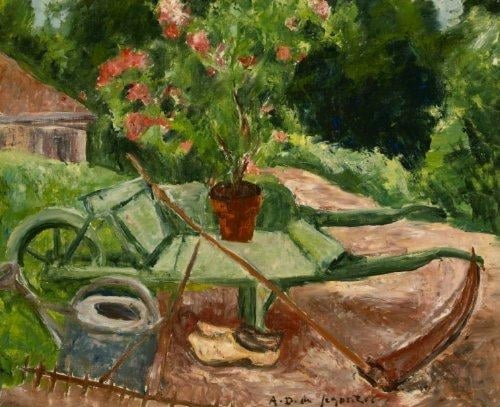
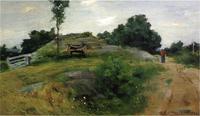
André Dunoyer de Segonzac’s La brouette (The Wheelbarrow) is a captivating example of how Impressionist landscape painting evolved to embrace both the fleeting effects of light and a renewed interest in the solidity of rural life. Although the artist is often associated with the later, more structured currents of Post-Impressionism and Fauvism, this work firmly roots itself in the Impressionist tradition while subtly asserting his personal vision—making it significant as a bridge between pure optical sensation and a more tactile, grounded representation of the French countryside.
Impressionist Foundations
True to the style, La brouette likely captures a momentary scene under open sky, focusing on the interplay of natural light and color. The wheelbarrow—a humble, utilitarian object—anchors the composition, serving as a focal point that draws the viewer into a pastoral setting. The artist’s brushwork would be swift and broken, with dabs of pure color meant to convey the shimmer of sunlight on leaves, soil, and the metallic or wooden surface of the cart. This approach aligns with the core Impressionist ambition: to record a transient visual impression rather than a detailed, permanent record.
Significance Within the Period
What makes La brouette particularly notable is how it showcases a shift within later Impressionism. By the early 20th century, when de Segonzac was active, many artists were moving away from the style’s purely atmospheric concerns. De Segonzac, however, retained the luminous palette and outdoor spontaneity of Impressionism while reintroducing a sense of structural weight. The wheelbarrow is not merely a light-suffused object; its form suggests labor, endurance, and human presence. This tension between ephemeral light and enduring rural toil gives the painting a quiet monumentality.
Furthermore, the choice of a wheelbarrow as the subject reflects the Impressionist interest in modern, everyday life—but here it is the everyday life of the farm rather than the Parisian boulevard. De Segonzac’s work often celebrated the simplicity and dignity of agricultural France, and La brouette stands as a testament to that commitment. It is significant because it demonstrates that Impressionism could still be vital and meaningful beyond its classic period, adapting to express both the beauty of nature and the resilience of human labor.
In essence, La brouette is a masterful landscape that honors the optical discoveries of Monet and Renoir while grounding them in a tangible, earthy reality—a subtle but important contribution to the legacy of Impressionist painting.
Visuell ähnlich
20 Werke mit ähnlicher Komposition und Farbpalette
My Garden Utensils or "My Yard in Utah"
James Taylor Harwood
Octave Chamouillet Pushing a Wheelbarrow in a Garden
Camille Corot
Kubikusok
Bela Czobel
Kubikusok
Bela Czobel
Egry József, Földmunkások
Egry József
Egry József, Földmunkások 1913
Egry József
Farmer cart under trees
August von Pettenkofen
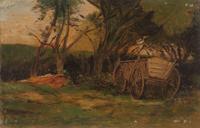
Farm carts under trees
August von Pettenkofen
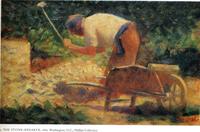
Stone Breaker and Wheelbarrow, Le Raincy
Georges Seurat
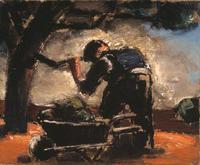
The Gardener
Josef Herman
Seated Woman
Frances Hodgkins
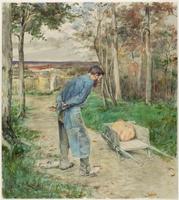
Illustration of La Fontaine's Fable of "the Acorn and the Pumpkin"
Jules Bastien-Lepage
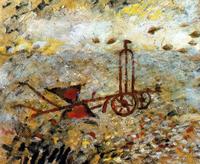
The Metallic Plow
Georges Braque
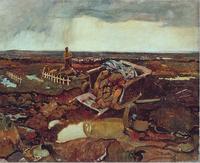
For What?
Frederick Varley
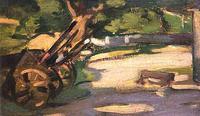
The Cart, Comrie, Perthshire
Samuel Peploe
The Old Gardener
Briton Riviere
Garden overlooking Oschwand
Cuno Amiet
The Garden
Gustave Caillebotte
Gathering Berries
James Charles
Connecticut Scene
Julian Alden Weir