Description
Stijl: Early Renaissance · Genre: sculpture
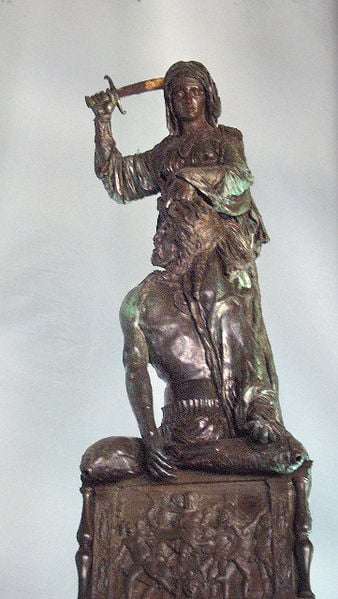
Donatello’s statue Judith and Holofernes (1457-1464) was commissioned by Cosimo de’ Medici to decorate the Medici Palace garden, where it was placed alongside Donatello’s bronze David (1440). The placement of the sculptures at the most public spaces of the palace and the center of Florentine’s political power explain their intention and function. Scholars have examined how iconography and composition of Judith and Holofernes relate to the political interests of the Medici family. Cosimo commissioned the sculpture at the time when he was working to overcome factionalism and discord in Florence. In 1433, Cosimo was exiled from Florence by Rinaldo Abizzi, but a year later, he returned and exiled Rinaldo. After his return, and especially throughout the 1450s, Cosimo worked on garnering support and unity among the members of his party.
The inscription on the statue sends a political message: “Kingdoms fall through luxury, cities rise through virtues; behold the neck of pride severed by humility.” As the inscription indicates, the biblical story of Judith is considered to be a battle between pride and humility. Judith is a moral, religious, and political heroine: she embodies how virtues of self-control, chastity, and humility triumph over Holofernes’s promiscuity and pride. Donatello highlights the contrast between virtues and vices in his depiction of the figures: Judith’s demure clothing and a veil covering her from head to toe represent chastity and humility. In contrast, Holofernes’s disheveled and almost naked appearance is associated with lust and pride. Holofernes wears a medallion hanging on his bareback. The medallion depicts a galloping horse, a symbol of pride, the vice traditionally defeated by humility. Furthermore, the necklace itself can be interpreted as a symbol of pride. For example, in Psalm 73:6, the necklace is associated with pride: “the wicked wear pride like a necklace and violence wraps around them”. The base of the sculpture has three reliefs that portray scenes of drunkenness. These relate to the biblical story: Judith encouraged Holofernes to drink, and after he falls asleep, she cuts his head off. These images serve as a complementary message, explaining the connection between pride and excessive drinking.
In Judith and Holofernes, Donatello dramatized the act of decapitation, the moment in which Judith is about to deliver the final blow to Holofernes. Donatello’s composition encourages the viewer to circle around the figures and observe the complex intertwining of their bodies. His depiction of Judith and Holofernes indicated to the viewer how the Medici wished to present themselves as embodiments of chastity and humility. At the same time, the dramatic portrayal of Judith slaying a tyrant symbolized the strength and stability of the Medici rule – a clear message to political rivals. Donatello enhanced this impression through his composition and use of symbolism. Today the sculpture can be seen at the Hall of Lilies at the Palazzo Vecchio in Florence. Additionally, there is a copy of the statue at the Piazza della Signoria, in front of the Palazzo Vecchio.
Visueel vergelijkbaar
20 werken met verwante compositie en kleurenpalet
The Call to Arms
Auguste Rodin
Psychomachia Or Victory of Virtue over Vice
Giambologna
The Wretched
Meta Vaux Warrick Fuller
Le Citoyen
Jean-Baptiste Pigalle
Unknown
Boris Schatz
Anacreon, Love and Bacchus
Jean-Leon Gerome
The Gladiators
Jean-Leon Gerome
Hercules
Antonio del Pollaiolo
Hercules and Anteus
Antonio del Pollaiolo
Time Arrested by Death
Gian Lorenzo Bernini
Sedina
Ludwig Manzel
Ganymede
Benvenuto Cellini
Labor
Stanisław Szukalski
Le Travail
Andre Massoulle
The Mature Age
Camille Claudel
Mathilde of Tuscany Sun
Gian Lorenzo Bernini
Fisherman
Emile Louis Picault
Parasites
Achille D'Orsi
Ugolino
Auguste Rodin
Achelous and Deianeira
Bartholomeus Spranger