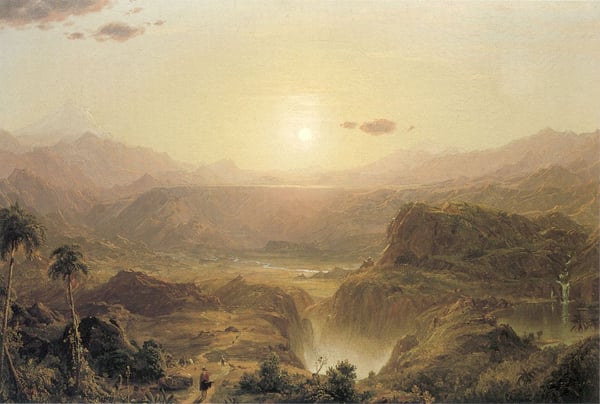
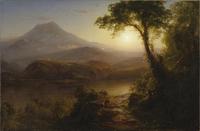
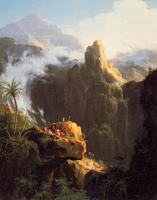
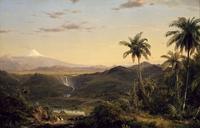
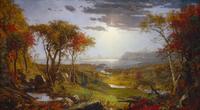
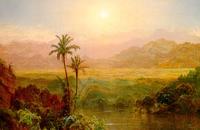
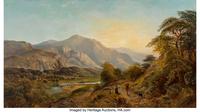
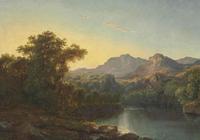
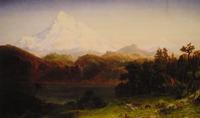
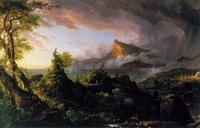
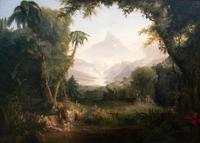
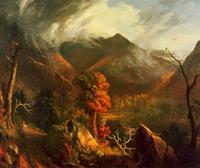
Frederic Edwin Church’s The Andes of Ecuador stands as a quintessential example of Luminism, a style within the Hudson River School that elevates light and atmosphere to the primary subject. The painting’s significance lies in how Church transforms a dramatic, vertically oriented landscape—soaring peaks, plunging valleys, and a foreground rich in tropical detail—into a radiant, almost spiritual vision of nature. There is no dramatic storm or human narrative; instead, the work achieves its power through the meticulous, nearly imperceptible gradations of light that suffuse the air, from the warm golden haze near the horizon to the cool, crystalline clarity of the highest snow-capped summits. This Luminist effect creates a profound stillness, as if time itself has paused, inviting the viewer into a meditative dialogue with the sublime. Church’s precise rendering of botanical and geological forms, combined with the glowing, ethereal atmosphere, demonstrates how Luminism could fuse scientific observation with transcendental awe—making the Andes not just a place, but a vision of divine order in the New World.