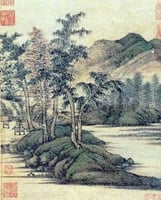
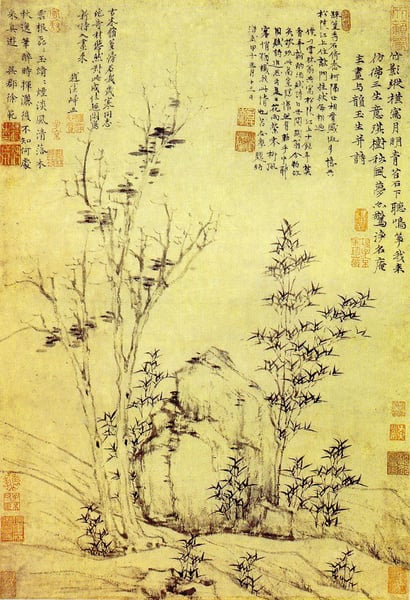
Analisi esperta di Autumn Wind in Gemstones Trees di Ni Zan
Stile: Ink and wash painting · Genere: landscape
Expert Analysis of "Autumn Wind in Gemstones Trees" by Ni Zan
Ni Zan (1301–1374) was a preeminent painter of the Yuan dynasty and a leading figure of the literati (wenren) tradition. His work epitomizes the scholarly ideal of painting as a form of personal expression, removed from the commercial or political constraints of his time. "Autumn Wind in Gemstones Trees"—likely a reference to a sparse grove of trees set against an austere landscape—perfectly illustrates Ni Zan’s hallmark style and philosophical depth.
Significance within Ink Wash Landscape Painting
Ni Zan’s landscapes are renowned for their radical minimalism. In this painting, the composition would typically feature a foreground with a few bare, wiry trees (perhaps the “gemstones” alluding to their jewel-like clarity or preciousness in autumn light), a vast expanse of empty water or mist in the middle ground, and distant, low-lying hills. The brushwork is dry and deliberate, using “hemp-fiber” texture strokes that are both disciplined and evocative. The ink wash is subtle, with pale tones that suggest a cool, breezy atmosphere—hence the “autumn wind.” This restrained palette and open space were not a lack of skill but a deliberate rejection of the more decorative, dense styles favored by court painters of the Song dynasty.
Literati Ideals and Personal Expression
Ni Zan’s significance lies in his embodiment of the xieyi (sketching the idea) approach. The “gemstones trees” might be a metaphor for the artist’s own moral purity—precious, resilient, and untarnished by worldly corruption. The vertical format and asymmetrical balance (a foreground islet with trees, a vast void, and a distant shore) create a sense of solitude and transcendence. Ni Zan famously refused to paint for the powerful Mongol court, and his landscapes often reflect a recluse’s detachment. The wind in the title suggests movement and impermanence, a Daoist and Buddhist contemplation of nature’s transience.
Influence and Legacy
This work is significant because it encapsulates the Yuan literati revolution: landscape as a vehicle for the artist’s inner state rather than a faithful depiction of nature. Ni Zan’s severe, spare aesthetic influenced later Ming and Qing painters, including Dong Qichang and the Four Wangs. "Autumn Wind in Gemstones Trees" stands as a masterclass in economy—every brushstroke carries emotional weight, and the empty space is as expressive as the ink. It is a quintessential example of how ink wash painting can achieve profound resonance through silence and suggestion.
Visivamente simili
20 opere con composizione e palette affini

Bamboo and Stone
Guan Daosheng
The Rongxi Studio
Ni Zan
Bamboo, and Elegant Stone
Ni Zan
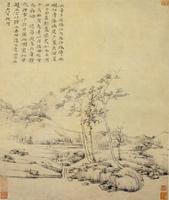
The Distant Cold Flow Pine
Ni Zan
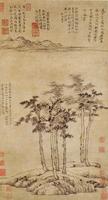
Six Gentlemen
Ni Zan
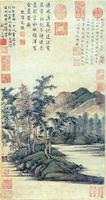
Water and Bamboo Dwelling
Ni Zan
Untitled
Xu Wei
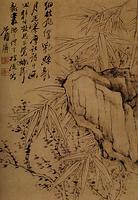
Bamboo and Rock
Shitao
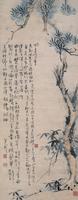
Three Friends of Winter
Bada Shanren

Landscape (Dong Yuan and Juran Style)
Bada Shanren
Dragon Stone
Emperor Huizong
柳汀灵禽
Qian Xuan
Sixteen Flowers
Xu Wei
Mountain
Utagawa Kuniyoshi
Go by the cold paths
Shitao

Flowers and Bamboo
Xu Wei
Trees in a River Valley in Yü shan
Ni Zan
The lonely Mountain
Shitao
楼台殿阁图
Qian Xuan
Snowscape
Tang Yin